Soundproofing your home for health and comfort

Written by Seamus McKale

Updated October 2, 2025 | Published September 3, 2025

There are several reasons to soundproof your home (or at least a few rooms within it). The soundproofing approach you take depends on your goals: are you trying to reduce street noise to help you sleep, or are you setting up a home recording studio?

In this article, we’ll explain the basics of soundproofing a home to reduce outside noise and improve your quality of life. Many of these techniques will also enhance the acoustics inside your home.

Thumbnail showing a woman with glasses napping on a grey couch

The important points

  • Noise is associated with many health and social issues, from sleep disturbance to mental health challenges.
  • Soundproofing means blocking sound from travelling into or out of a room, while sound absorption reduces echo and reverb within the room.
  • There are many ways to reduce outside noise, but true soundproofing is expensive and requires renovation.

Why soundproofing is important

Some people are more bothered by noise than others. But, there are very real health issues associated with noise. If you live in a neighbourhood with a lot of traffic and street noise, or in an apartment building with noisy neighbours, an investment in soundproofing is an investment in your well-being.

Noise is associated with many health and social issues, including:

  • Hearing impairment
  • Sleep disturbances
  • Cardiovascular issues
  • Mental health disturbances
  • Social disturbances
  • Annoyance reactions

Your brain can subconsciously perceive even minor noises as danger, including those at night that don’t wake you up.1

“While we might not wake up, we might not be annoyed or disturbed by a sound, we’re still going to register those sounds and our nervous system is still going to process that to some extent,” said Dr. Tor Oiamo on CBC’s The Dose. “And there’s going to be some small response that can cascade in various forms and at various levels throughout our body.

“If we do not immediately or familiarly know that it’s not a harmful threat, it does cascade, and a bit of a stress response goes through the system.

“And over time, just small stimulations of that system releasing even small amounts of those stress hormones, can lead to pretty serious outcomes over several years or decades. And that’s where we see those— the worst health outcomes that are associated with excessive noise exposure, like cardiovascular disease.”2

Noise can cause long-term health issues, even when it’s quiet enough to sleep through.

You can reduce or eliminate these issues by soundproofing your home (or at least the rooms in which you spend the most time). To accomplish this, it’s important to start with an understanding of how sound travels into and throughout your home.

How does sound travel through rooms?

The physics of sound are complicated. Luckily, you don’t need to be an expert to improve the soundproofing in your home.

Sound is an oscillation in pressure — basically, vibration — which travels as waves through a medium.3 All materials (solid, gas, or liquid) conduct some sound. As sound waves interact with different media, some are reflected, and others travel through. Solid, dense materials resist vibrations, stopping or reflecting most sound. Porous materials (like foam) interrupt and absorb sound waves.4

When dealing with home soundproofing, there are two types of noise to understand:

  • Airborne noise: sound travelling through the air. When you’re talking to someone face-to-face, the sound of their voice is airborne. Same thing with common nuisance noises like your neighbour’s TV or the sound of traffic on the street.
  • Impact noise: sound travelling through solid media that is created by physical objects striking one another. Your upstairs neighbour’s thumping footsteps? Impact noise. The sound still has to travel through the air to reach your ear from the ceiling, but the origin is a solid impact.

Impact noise tends to be louder and more difficult to block. However, many people report that airborne noise is more annoying. In buildings made of lightweight materials (like wood), both types of noise can travel relatively easily between rooms and living units.5
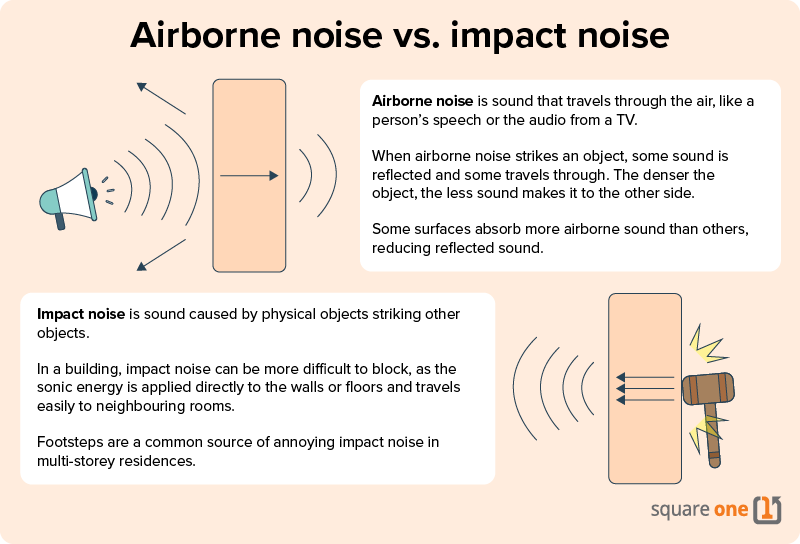
A graphic demonstrating the difference between airborne and impact noise. Airborne noise travels through the air, illustrated with a megaphone bouncing sound off a wall. Impact noise travels directly through solid media, illustrated by a hammer striking a wall.

It’s also important to understand the difference between soundproofing and sound absorption:

  • Soundproofing means blocking sound from travelling into a room. This is generally accomplished with layers of dense material and airtight sealing. It’s difficult to do in an already constructed home without renovations.
  • Sound absorption means reducing the echo and reverb of sound within a room. Sound-absorbing materials may reduce some outside airborne noise if used properly. But, they aren’t very effective at blocking impact noise.

To reduce noise inside your home, there are two strategies: increase the mass that the noise has to travel through, or add dampening materials to diffuse and absorb the noise. The former is usually more expensive and more effective, while the latter can be done on the cheap (with mixed results). The more you do, the more soundproof your room will be.

Consider this, too:

The most effective way to reduce noise is to eliminate the source of the noise. That’s often impossible, but if your issue is the footsteps of upstairs neighbours or the loud stereo next door, addressing the issue with the noisemakers may be far more effective than spending time and money on soundproofing.

Related articles

How to soundproof a room from outside noise

To soundproof a room, you’ll need to look at every outside-adjacent surface: floors, walls, and ceiling. In particular, you’ll need to make sure your doors and windows aren’t leaking excess noise. Depending on the source of your noise and your soundproofing needs, you may be able to make do with some everyday household items.

Doors

  1. Hollow-core vs. solid-core doors. Hollow-core doors have a cavity inside and are significantly lighter than their solid counterparts. Replace any hollow-core doors with solid-core doors to block more noise.
  2. Gap sealing. If there are any visible gaps around your door, seal them. Use weatherstripping, door sweeps, or (if the problem is really bad) redo the door frame so the door closes snugly all around.

Windows

  1. Single- vs. double-pane windows. Single-pane windows don’t block a whole lot of noise. Double-pane (or even triple-pane) windows have more glass and more air-gap layers to block and diffuse sound waves before they get inside.
  2. Gap sealing. Just like doors, windows often have small gaps around their frame. Seal any gaps around your windows with caulk. You can even buy acoustic caulk if you’re really ambitious, but the regular stuff works just fine.
  3. Window coverings. Heavy drapes or curtains, when closed, will block at least some noise coming through the windows — the heavier, the better. You can also install removable transparent panels in front of your windows, adding an extra noise-blocking layer and ensuring a tight seal.

Walls

  1. Wall hangings. Heavy, thick wall hangings absorb a lot of sound, especially those that are soft (like a hanging rug). You can buy purpose-built acoustic panels, but bear in mind that these are typically meant to improve the sound inside your room, not block outside sound. Hanging a heavy quilt can work, too.
  2. Insulation. The insulation inside your walls is a major factor in how much sound travels through them. The right insulation can block a lot of sound; denim insulation (yes, that kind of denim) is one of the best.6 Obviously, replacing your insulation isn’t cheap or simple, but it is effective.
  3. Sound-blocking layers. If you’re opening up the walls to redo your insulation, consider adding an extra sound-blocking layer between the insulation and the drywall. Sheets of mass-loaded vinyl, for example, add mass to your walls to prevent sound from travelling through. Adding additional drywall layers accomplishes the same thing.

Floors

  1. Floor coverings. Adding thick rugs or a layer of carpet will dampen noise coming from below. As an added bonus for apartment dwellers, it will also reduce impact noise travelling from your unit into your downstairs neighbour’s.
  2. Sublayers. Tearing up your flooring to add a sound-blocking sublayer isn’t quick or easy, but there’s little else you can do aside from adding a covering. There are many soundproofing underlay products available — cork or rubber, for example, are effective materials.

Ceilings

  1. Add mass. Like any other surface, adding dense layers to your ceiling will absorb more sound coming through. An extra layer of drywall is the most straightforward method, but it does require extensive construction.
  2. Acoustic ceiling tiles. If you have a suspended ceiling, you can buy acoustic panels to replace the standard tiles. There are different types of acoustic panels available, many of which will block some noise travelling from other rooms.

It only takes 5 minutes

ready for an online quote? Your time matters, and so does your stuff. Get a personalized home insurance quote in 5 minutes. That’s less time than it takes to wait in line for coffee.

Before you start, please review our Privacy Policy and Terms of Use.

Common soundproofing mistakes

Before you get carried away with spending thousands of dollars on acoustic panels or tearing up your floorboards, consider these common mistakes people make when trying to reduce outside noise.

  1. Not identifying the issue and their goals. The noise you’re trying to block will determine the most effective methods at your disposal. Traffic noise from outside needs different soundproofing techniques than footsteps from the upstairs neighbours, for example.
  2. Using the wrong materials. Some soundproofing gear is meant to address sound within the room, rather than sound entering from elsewhere. Materials meant for a recording studio may or may not be helpful in reducing outside noise.
  3. Underestimating impact noise. If your primary issue is impact noise (like footsteps from upstairs), you may have a difficult time soundproofing against it. Low frequency sounds tend to travel much further, even through solids; footsteps and other impacts peak at low frequencies.7
  4. Overlooking gaps. A lot of sound leaks through tiny gaps around windows or doors, and these gaps are usually quick, easy, and cheap to seal.
  5. Air circulation. Sealing up your windows and furnace ducts might reduce sound transmission (including from noisy HVAC machinery), but don’t forget that you still need fresh air.
  6. Overdoing it. Even if you spend piles of money, you likely won’t be able to isolate a room completely from outside noise. Moreover, excessive sound dampening can actually make a space less livable.8 Focus on reducing the most annoying noises.
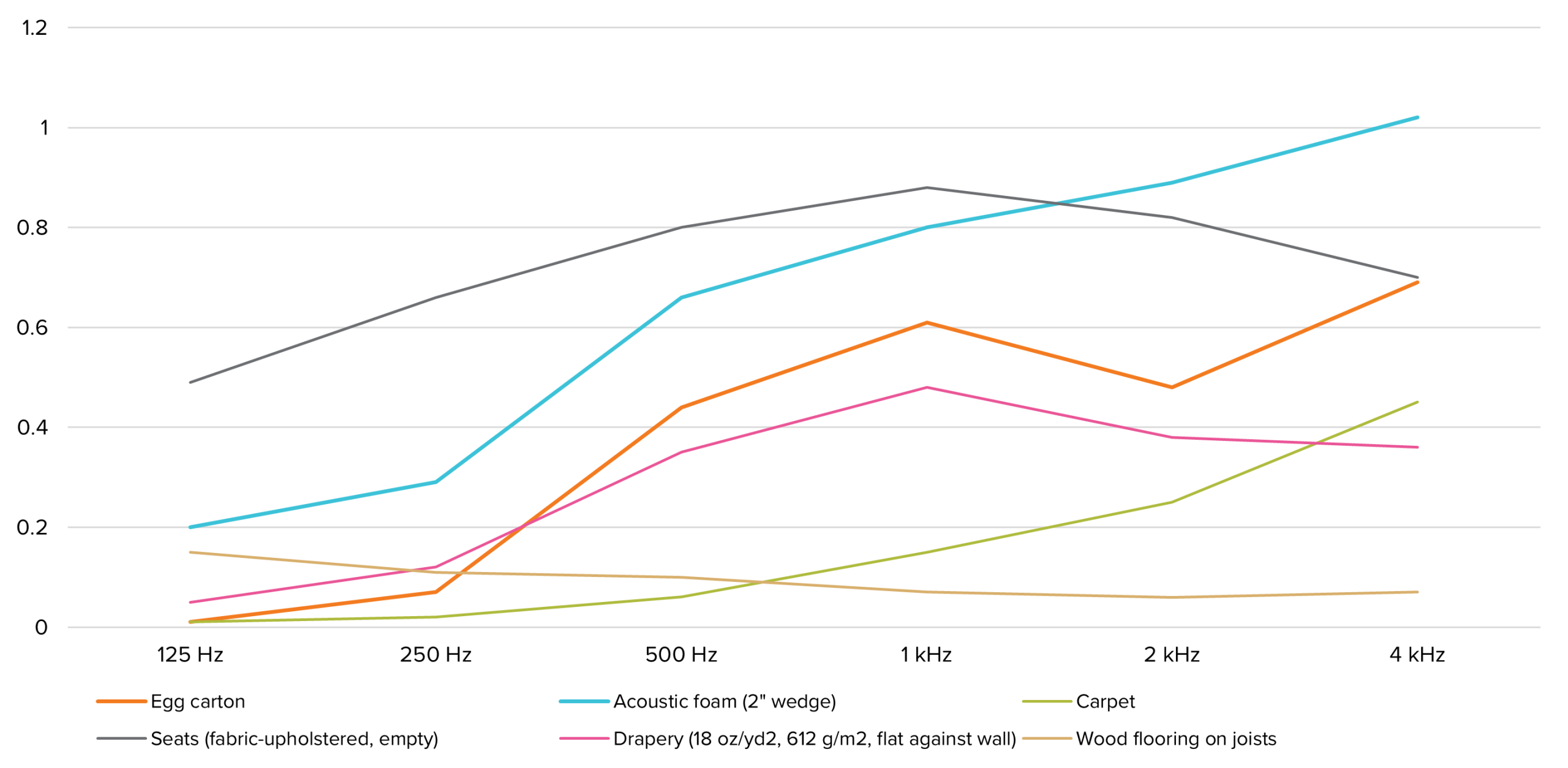
  7. Relying on egg cartons. Lining your walls with egg cartons is a common DIY soundproofing hack. However, egg cartons won’t block much outside noise. They are potentially useful for improving in-room acoustics, however, because they’re reasonably effective at sound absorption.

Sound absorption coefficient by frequency 9 10 11

Graph of sound absorption coefficients of several common soundproofing materials: egg cartons, acoustic foam, carpet, upholstered seats, draperies, and wood flooring

Soundproofing costs

The cost of soundproofing ranges from a few dollars to over $10,000 depending on how soundproof you need the room to be. If you’re renovating a room to install mass-loaded vinyl and cork underlays, expect to pay a lot. Advanced soundproofing costs at least $10 per square foot, or a minimum $1,500 for a 12×12 room.

But, if you’re just looking to reduce the level of outside noise a little, there are some budget-friendly options to focus on. These work whether you’re a house owner or an apartment renter in need of temporary soundproofing solutions:

  • Heavy drapes: under $100
  • Window insulation kits: $50–100
  • Door stoppers: under $25
  • A tube of acoustic sealant: under $10
  • Large area rugs: under $100
  • A roll of weatherstripping tape: under $10

If you’re looking to achieve true soundproofing, consider consulting a professional before starting any building or renovation project. For more information on advanced, studio-level soundproofing, start with this guide to home studio soundproofing.

Home insurance considerations

As you soundproof your home, there are a couple of things to keep in mind regarding your home insurance policy. If your soundproofing project involves expensive equipment or renovations, make sure you consider whether you need to increase your coverage limits.

  • Anything fixed to the structure of your home (like drywall or mass-loaded vinyl layers) would fall under your building coverage.
  • Anything that’s not permanently fixed (like wall hangings or rugs) would be part of your contents coverage.

If you’re planning extensive renovations, make sure you inform your home insurance provider. Most policies require that you inform your provider of any renovations costing more than $5,000. Your provider will help you adjust coverage limits as needed.

Commonly asked questions

What should you consider besides soundproofing?

If you’re dealing with outside noise, you don’t necessarily have to soundproof your room.

For example, if your issue is noise disrupting your sleep, consider a white noise machine. White noise reduces the effect of environmental noise on sleep, as long as the white noise is louder than the annoyance.12 Earplugs are another option for improved sleep, especially custom-fitted earplugs.

When you’re dealing with noise disturbances from your neighbours, sometimes the best solution is talking to them. Many people don’t realize how much noise they make. You might, for example, convince your upstairs neighbours to get an area rug to dampen the sound of their footsteps.

Are there legal considerations for soundproofing?

Most of the time, there are no legal hoops to jump through when you’re soundproofing a room. However, if you need to do any renovations to a rented home, you’ll probably need approval from your landlord before making any serious changes. As a homeowner, you don’t need to worry about much. However, if you’re planning extreme soundproofing renovations, make sure you’re aware of any building permits you’ll need beforehand. If you install a lot of expensive soundproofing equipment, you may need to increase your home insurance coverage limits.

How do you soundproof a basement room?

Soundproofing a basement room is just like any other, but with one great benefit: you don’t need to worry about noise coming through the floor. Add mass to the walls and ceiling to keep noise from travelling through. Install acoustic pads (or other wall hangings) to improve the in-room acoustics.

Sources

  1. Goines, Lisa and Hagler, Louis. “Noise Pollution: A Modern Plague.” Southern Medical Journal, vol. 100, no. 3, 2007, pp. 287–294.
  2. “How is the noise around me harming my health?” The Dose from CBC, 22 Jun. 2023, www.cbc.ca/listen/cbc-podcasts/410-the-dose/episode/15992822-how-is-the-noise-around-me-harming-my-health.
  3. “Sound.” Acoustical Society of America, asastandards.org/terms/sound-2. Accessed 5 Aug. 2025.
  4. Song, Siyuan. “Sound Propagation in Porous Media: Numerical simulation based on MATLAB.” Brown.edu, 15 Dec. 2017, www.brown.edu/Departments/Engineering/Courses/En2340/Projects/Projects_2017/Siyuan_Song.pdf.
  5. Rindel, Jens Holger, and Rasmussen, Birgit. “Assessment of airborne and impact noise from neighbours.” Proceedings Inter-Noise 1997, Aug. 1997, pp. 1739-1744.
  6. Baron, Jennifer. “Comparative Study of Soundproofing and Sound Dampening Insulation.” jenniferlbaron.wordpress.com, 13 June 2013, jenniferlbaron.wordpress.com/wp-content/uploads/2013/10/baron-jennifer-eng235-final-report.pdf.
  7. “How to Block Loud Footstep Noise from an Upstairs Apartment?” NoisyWorld, noisyworld.org/how-to-block-footstep-noise. Accessed 5 Aug. 2025.
  8. Clark, C., et al. “Evidence Review for Effects of Soundproofing on Residents’ Wellbeing and Alternative Designs.” Proceedings of the Institute of Acoustics, vol. 45, no. 3, 2023, discovery.ucl.ac.uk/id/eprint/10188520/1/c_clark_j_kang_l_lavia_et_al_evidence_review_for_effects_of_soundproofing_on_residents_wellbeing_alternative_designs.pdf.
  9. Riverbank Acoustical Laboratories. “Egg Crates: Sound Absorption Test, RAL–A88-80.” 28 Mar. 1988, acousticalsolutions.com/wp-content/uploads/2018/05/as-egg-carton-sound-absorption-test.pdf. Accessed 5 Aug. 2025.
  10. “Absorption coefficients of common building materials and finishes.” Acoustic-supplies.com, www.acoustic-supplies.com/absorption-coefficient-chart/. Accessed 5 Aug. 2025.
  11. “How Thickness of Acoustic Foam Panels Affects Absorption” soundassured.com, www.soundassured.com/blogs/blog/how-thickness-of-acoustic-foam-panels-affects-absorption. Accessed 5 Aug. 2025.
  12. Ebben, M., et al. “The effects of white noise on sleep and duration in individuals living in a high noise environment in New York City.” Sleep Medicine, vol. 83, July 2021, pp. 256–259, doi.org/10.1016/j.sleep.2021.03.031.

Want to learn more? Visit our Home Improvement resource centre for tips and inspiration for your next big home improvement project. Or, get an online quote in under 5 minutes and find out how affordable personalized home insurance can be.

Computer

Get a free quote

Get a personalized online home insurance quote in just 5 minutes and see how much money you can save by switching to Square One.

Get an online quote now

People

Protect your family

Even when you take precautions, accidents can happen. Home insurance is one way to protect your family against financial losses from accidents. And, home insurance can start from as little as $15/month.

Learn more