Insurance for classic and collectible cars

Written by Seamus McKale

Reviewed by Sunny Dhiman

Updated December 9, 2025 | Published December 9, 2025

Classic, collectible, antique… call them what you like, old cars still need insurance. And not just any insurance — insurance that treats them as they are: unique, valuable, and often irreplaceable.

This is your guide to insurance for classic or collectible vehicles, including how it works, how to get it, and which vehicles qualify.

Note: Square One does not currently offer classic car insurance.

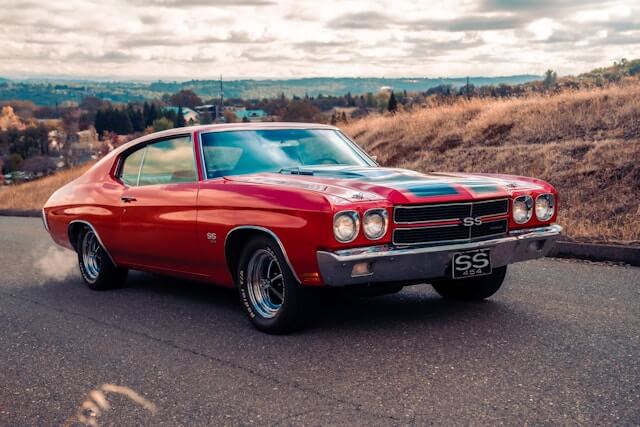
A red 1970 Camaro driving on a road in the countryside on a cloudy day

The important points

  • Classic car insurance covers vehicles that are more than about 25 years old and are intended primarily for show rather than daily use.
  • The main difference between classic and other car insurance is that classic car insurance guarantees the value of the insured vehicle.
  • The definition of a classic, vintage, or collector vehicle differs between insurance providers.

What is classic car insurance?

Classic car insurance is designed for older vehicles that are primarily intended for display and aren’t driven regularly. It’s also called antique, vintage, or collectible vehicle insurance.

What does classic car insurance cover?

Car insurance in Canada is mandatory and highly regulated. Accordingly, many parts of a classic car insurance policy are just like you’d expect from any car insurance.

Classic car insurance includes, at a minimum, third-party liability coverage. That’s the part you need to legally drive a vehicle anywhere in Canada; it protects the driver if they’re at fault for injuries or damage to others’ property.

Where classic car insurance differs from typical insurance is how it covers the vehicle itself.

Most classic car policies include options like comprehensive and collision coverage (or all perils, which combines the two). These cover damage to the vehicle itself. Many policies include non-insurance extras, such as roadside assistance.

Those coverages are available for most vehicles, of course.

Related articles

The unique parts of classic car insurance are the specialized coverage options that aren’t part of most standard policies. Those might include:

  • Spare parts coverage protects spare parts that aren’t attached to the insured car.
  • Evacuation expense coverage is for costs associated with moving your classic car during an evacuation event.
  • Broader salvage options permit the owner to keep the wreckage if their car is a total loss, and still receive the full-value settlement. Typically, the insurer would negotiate a reduced settlement if it agreed to let the owner keep the salvage.
  • Market value increase coverage allows settlements over the coverage limit if the car’s value exceeds that limit due to appreciation in its worth over the policy term.
  • Under-construction coverage protects the vehicle while restoration or repair is underway.

One of the biggest differences between everyday car insurance and classic car insurance is how the policy values the insured car.

Guaranteed value

Classic or collector car policies usually insure the car for a guaranteed value, also called an agreed value.

Guaranteed value means that the car’s owner and the insurer together predetermine a fair value for the vehicle, and the policy insures it for up to that amount. It often requires an independent appraisal, which accounts for the vehicle’s quality, rarity, and value to collectors.

This differs from typical car insurance policies, which usually insure vehicles based on their actual cash value immediately before an accident. Actual cash value (ACV) refers to the vehicle’s estimated worth at a given moment in time. You might also hear it referred to as depreciated value or market value. Each car insurance policy describes the basis it uses to determine the value, in any case.

Insurers calculate ACV based on recent sales of similar vehicles in the area, their own internal data, and, in some cases, input from an appraiser. Thus, a vehicle’s ACV can fluctuate, and it declines as the vehicle ages.

Classic or collector cars, on the other hand, often see their value increase over time. Agreed value helps avoid the coverage gap that can exist between a collector vehicle’s depreciated value and its actual market worth. It ensures that the vehicle’s owner knows beforehand what they’ll get if their car is totalled.

How does classic car insurance work?

Classic car insurance works similarly to standard car insurance. To get it, you find a provider, complete their application, and, if everything looks good, they sell you a policy.

When you apply for classic, collector, or antique car insurance, you’ll have to demonstrate that you and your car qualify. Once you have the policy, you’ll need to adhere to certain restrictions. Many limitations are just like any car insurance policy, but others are stricter:

  1. Driver details. Classic car insurance providers often have strict rules about drivers’ experience and driving history. Serious convictions (like impaired driving or reckless driving) are usually disqualifying.
  2. Vehicle details. The vehicle must meet the provider’s definition of classic, collectible, or vintage (more on this below).
  3. Vehicle usage. Classic or collectible cars can’t be daily drivers. Some policies allow reasonable pleasure use, usually limiting mileage to 5,000 kilometres per year or so. Others restrict usage only to special occasions, like driving to a car show or in a parade.1
  4. Storage. Most policies require the insured vehicle to be stored securely indoors.
  5. Vehicle condition. Many policies require collector vehicles to be as close to factory specifications as possible. That means no damage and no modifications, though some policies permit more modification than others.
  6. Maintenance and upkeep. Often, collector or classic vehicles must be repaired with original manufacturer parts wherever possible. It’s expected that the owner will keep the vehicle in good-to-great shape.

How much does classic car insurance cost?

Despite the higher value of classic cars, classic car insurance is often less expensive than typical car insurance. Classics spend less time on the road and their owners take better care of them compared to average cars, so they’re much less likely to suffer damage.

Another factor is the stricter limitation on driver experience for classic car policies. Safe drivers with accident-free histories qualify for discounts on most policies, and classic car insurance is no exception.

Of course, there are many factors involved in calculating car insurance premiums. Not every classic car policy will be cheap, but the average cost is comparatively low.

It only takes 5 minutes

ready for an online quote? Your time matters, and so does your car. Get a personalized car insurance quote in 5 minutes. That’s less time than it takes to wait in line for coffee. Car insurance is available in Ontario and Quebec.

Before you start, please review our Privacy Policy and Terms of Use.

What qualifies a car as classic, collectible, or antique?

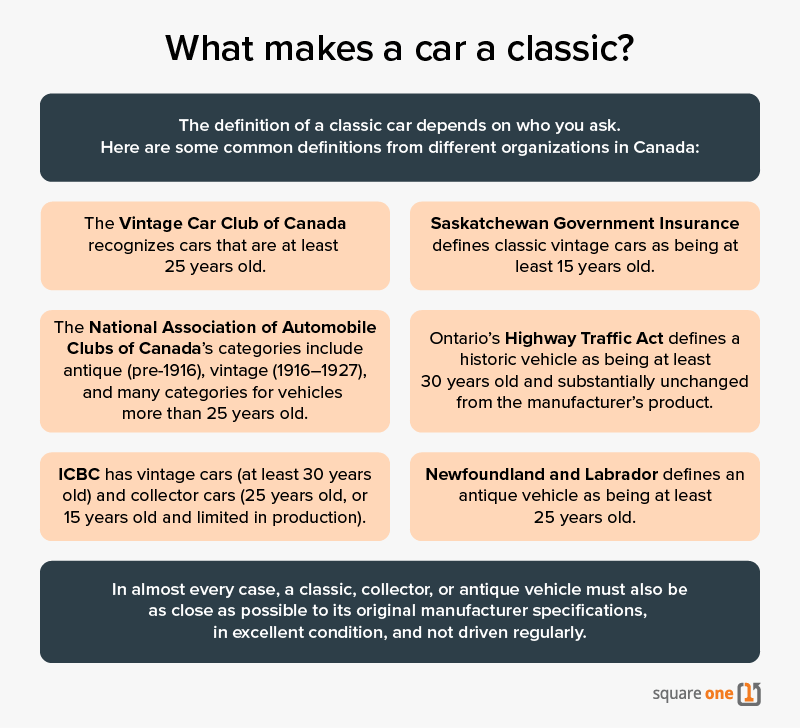
You might call an old car a “classic,” an “antique,” or maybe a “vintage” vehicle. In some ways, these terms are interchangeable — but it all depends on who you ask.

Generally, a classic car is at least 25 years old. The vehicle must be unmodified from its manufacturer’s specifications to be a collector car. And, it mustn’t be the owner’s daily-use vehicle — it should be driven only occasionally and kept securely indoors most of the time.

However, these criteria aren’t always the same.

Most provinces have a special type of registration for classic cars, often coming with a special licence plate and strict limitations on how it’s allowed to be used. Many insurance providers require a vehicle be formally registered as classic before they’ll insure it as a classic car. In some provinces, classic cars are a totally separate class of vehicle, meaning insurers need regulatory approval to insure them — and some don’t bother getting it.

A classic car that’s not officially registered may still qualify for regular insurance. But, it probably wouldn’t qualify for the same benefits as registered classics, like lower premiums.

So, there is no universal definition of a classic or collectible car, but here are some organization-specific examples:

  • The Vintage Car Club of Canada recognizes vehicles that are at least 25 years old.2
  • The National Association of Automobile Clubs of Canada’s categories include antique (pre-1916) and vintage (1916–1927), as well as numerous categories for vehicles at least 25 years old.3
  • In BC, ICBC categorizes vintage cars (at least 30 years old and conforming to manufacturer specifications) as well as collector cars (25 years old, or 15 years old and a limited production or discontinued vehicle).1 4
  • In Saskatchewan, SGI defines classic vintage vehicles as being at least 15 years old with no modifications.5
  • Ontario’s Highway Traffic Act defines a historic vehicle as being at least 30 years old and “substantially unchanged” from the manufacturer’s product.6

You’ll need to check with your insurance provider to learn their requirements for classic car insurance, if they even offer it.

Commonly asked questions

Is it worth restoring a classic car vs. buying one?

If you’re interested in buying a run-down classic and restoring it yourself, you need to be in it for the love of the game. Don’t expect the return on investment (time or money) to be worthwhile from a financial point of view. It’s less expensive to purchase a car that’s already been restored.7

Time-wise, expect to spend 1,500 to 2,000 hours restoring a common, North American model. Add a few hundred (or thousand) hours for rare or exotic models. The cost can be $60,000 for even a modest project.8 At the end of the project, don’t expect to resell the car at a profit, either.

Are there common reasons for claim denials with classic car insurance?

A typical reason for denied claims or coverage would be a breach of the policy’s restrictions on vehicle usage.

Classic car policies don’t allow the insured vehicle to be used as a daily commuter, for example — if it’s revealed that you were doing so, a subsequent claim could be denied. Similarly, if the policy required the vehicle to be stored in a locked garage, and the insurer discovered it was stored on the street, they could deny coverage

Classic car policies feature the same standard exclusions as standard car insurance. For example, exclusions for impaired driving, or damage from nuclear events or terrorism.

How do you get classic car insurance?

To buy classic car insurance, first, you need to find a provider that offers it; many typical car insurance providers, including Square One, do not. Once you’ve done so, the application process is much like any other car insurance policy. Often, you can even complete the quote process entirely online.

You’ll need to provide details about yourself, like your driving and insurance history. Then, details about your vehicle. Where classic car insurance differs is that you may need some additional documentation. For example, you’ll often need to have the vehicle appraised to qualify for guaranteed value coverage.

You may also need to demonstrate that the vehicle meets certain quality standards to qualify as a collector. For example, ICBC’s application for collector status requires the vehicle be stock, damage-free, and clean — inside and out. They also require photographs of specific parts of the car.

Sources

  1. ICBC. “Vintage vehicles.” icbc.com, www.icbc.com/vehicle-registration/collector-mods/Vintage-vehicles. Accessed 10 September 2025.
  2. Vintage Car Club of Canada. “About.” vccc.com, vccc.com/about. Accessed 10 September 2025.
  3. Carlson, John. “NAACC National Judging Guidelines.” 10 January, 2018, www.naacc.ca/knowledge/judging-resources/naacc-national-judging-guidelines/.
  4. ICBC. “Collector vehicles.” icbc.com, www.icbc.com/vehicle-registration/collector-mods/collector-vehicles. Accessed 10 September 2025.
  5. SGI Canada. “Personal auto insurance.” sgicanada.ca, sgicanada.ca/auto-details. Accessed 10 September 2025.
  6. Highway Traffic Act. “R.S.O. 1990, Chapter H.8.” ontario.ca, 26 November, 2025, www.ontario.ca/laws/statute/90h08.
  7. Linden, Steve. “Restoring Classic Cars Doesn’t Make Financial Sense — But Can be Worthwhile.” Newsday, 31 May 2013, www.newsday.com/classifieds/cars/restoring-classic-cars-doesn-t-make-financial-sense-but-can-be-worthwhile-j34937.
  8. Edwards, Alyn. “Collector Classics: Why it Costs So Much to Restore or Modify a Classic.” Driving, 15 June 2018, driving.ca/column/collector-classics/collector-classics-why-it-costs-so-much-to-restore-or-modify-a-classic.

Want to learn more? Visit our Car insurance resource centre for dozens of helpful articles. Or, get an online car insurance quote in under 5 minutes and find out how affordable personalized coverage can be.

About the expert: Sunny Dhiman

Sunny has been with Square One since 2017, and presently holds the title of Call Centre Manager. Sunny is responsible for training and coaching new and exisiting employees. He also advises on complex underwriting, quote, or policy related matters. Sunny has a level 2 general insurance licence in BC, Alberta, Manitoba, and Saskatchewan. He has an OTL licence in Ontario and an AMF licence in Quebec. Sunny is also working on CAIB and CIP designations.

Computer

Get a free quote

Get a personalized online home insurance quote in just 5 minutes and see how much money you can save by switching to Square One.

Get an online quote now

People

Protect your family

Even when you take precautions, accidents can happen. Home insurance is one way to protect your family against financial losses from accidents. And, home insurance can start from as little as $15/month.

Learn more