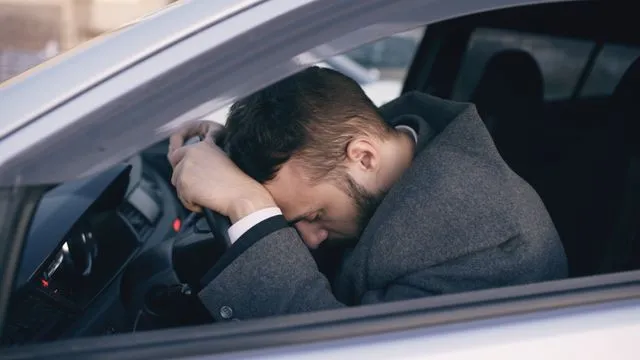
8 tips for managing driver fatigue
If you’re tired to begin with, the safest decision is obvious: don’t drive. Even if you feel fatigue setting in mid-drive, don’t try to push through it — pull over somewhere safe and rest. Below are some measures you should keep in mind to avoid compromising your safety.
Consider the following measures before a trip:
- Get a full night’s sleep before any long or demanding drive. Sleep deprivation can impair concentration, decision-making, and reaction time. Starting a trip well-rested helps ensure you remain attentive throughout the drive — or at the very least, longer than if you were running on little sleep.
- Avoid driving during your normal sleeping hours. During this window, alertness declines and the risk of fatigue-related errors increases. Plan your trips for times when you’d normally be awake.
- Never drive after consuming alcohol, cannabis, or other drugs. Not only do they impair your judgment, slow your reaction time, and cause drowsiness, but they also endanger your life and the lives of others in your car. Not to mention, impaired driving is illegal.
- Avoid visually fatiguing activities. In the hours leading up to a road trip, avoid anything that requires intense eye concentration. Eye fatigue can result from things like reading, using devices in the dark, sitting in front of a fan, and more.10 Driving at night or under glaring sun is also eye-straining, so make sure you’re not irritating them beforehand, and wear sunglasses on bright days.
- Check your medications. If you’ve been prescribed anything with sedative effects, be mindful of how it affects you and whether it’ll interfere with your ability to drive safely. Check the labels for other possible side effects. You may want to consult a health professional if you’ve recently started something new.
- Use caffeine sparingly. Caffeinated beverages will perk you up, especially if you’re already tired. Be cautious, though. The effects of caffeine can differ from person to person and based on how much and when it’s consumed — have too much late in the day, and you may have trouble when it’s time to sleep. Caffeine has been shown to reduce sleepiness and improve driving performance, but it shouldn’t be considered a substitute for getting the right amount of sleep.11
- Plan a route and trip you can handle. Before you set off, map out the path you’ll be taking and identify the rest areas along the way. Rest stops are typically situated alongside fuel stations and may contain restaurants, shops, and other facilities. Even if your route has no official stops, it’s still beneficial to pull over periodically anyway. If another licensed driver is travelling with you, consider taking turns operating the vehicle. This way, each driver gets to recharge before clocking their next stretch of miles.
If you sense drowsiness developing while driving:
- Pull over and rest. It’s safest to do so the moment you feel drowsy. For those long, boring drives, make it a habit to stop every two hours or so. While you’re at it, step out of the car, stretch, and take in some fresh air. Remember, no amount of caffeine, loud music, or willpower can override exhaustion, especially if your body’s fighting to stay awake. If a break isn’t enough, hand the wheel to someone else. Or, call a taxi or someone you trust to pick you up, and return for your car once you’re properly rested — assuming it’s parked somewhere safe and legal, of course.
Commonly asked questions
When are fatigue-related accidents most likely to occur?
Generally, fatigue-related crashes can happen at any time of day. However, they’re most common at night, especially the late-night to early-morning hours. During these times, the body is programmed to be asleep, so there’s a serious risk of fatigue impairing the ability to drive safely.
The mid-afternoon is another common window for such accidents, due to the energy dip many people experience then.
Even a well-rested driver can experience mild symptoms of fatigue during a late-night drive home or even an afternoon commute. If someone’s already sleep-deprived, however, the risk of a fatigue-related crash increases significantly — regardless of the time of day.
Are there any fatigued driving laws in Canada?
No. Canada doesn’t have any standalone fatigued driving laws, at least not in the way it has laws against impaired driving, distracted driving, or other driving-related offences. There’s just no way for law enforcement to physically measure fatigue (unlike alcohol), especially after a car accident.
If you’re tired, you may make mistakes. If you do something like run a red light or drift into oncoming lanes, an officer can pull you over and ticket you for careless or dangerous driving. In Ontario and many other provinces, these offences can also result in demerit points.
How does car insurance deal with driver fatigue?
Car insurance doesn’t treat fatigue as its own category. If you fall asleep at the wheel and crash, your claim gets handled like any other at-fault accident. If it’s determined that you were at fault, you’d still rely on collision coverage for your car’s repairs.
How the police handle it is a separate matter, but it can affect your insurance too. While there’s no ticket for being tired specifically, if your fatigue led you to speed or drive dangerously, you could be charged and convicted of such offences. This can affect your premiums, and sometimes even your eligibility for insurance coverage.
Either way, an at-fault accident will likely raise your premiums at renewal, no matter what behaviour caused it.
Are driver monitoring systems effective at preventing fatigue-related crashes?
Yes, to an extent.
Driver monitoring systems (DMS) are designed to alert drivers when they detect potential drowsiness or inattention. When this happens, it’ll typically issue visual or audible alerts to encourage the driver to refocus on the road — or pull over and rest.
Many newer vehicles use driver-facing cameras to monitor eye and head movement for signs of fatigue. Some systems also evaluate driving behaviour, such as lane positioning or steering inputs. Some can also intervene by applying the brakes if the driver doesn’t respond to the initial alerts.12
Sources
- Safety Canada. “Driver fatigue: falling asleep at the wheel.” Canada Safety Council, April 2009, https://canadasafetycouncil.org/wp-content/uploads/2018/01/newsletter-apr-2009.pdf.
- Transport Canada. “Canadian Motor Vehicle Traffic Collision Statistics: 2023.” tc.canada.ca, https://tc.canada.ca/en/road-transportation/statistics-data/canadian-motor-vehicle-traffic-collision-statistics/2023/canadian-motor-vehicle-traffic-collision-statistics-2023. Accessed 21 July 2026.
- Department of Justice Canada. “Impaired driving laws.” justice.gc.ca, 3 Mar. 2022, https://www.justice.gc.ca/eng/cj-jp/sidl-rlcfa/.
- Diagnostic Classification Steering Committee. “The international classification of sleep disorders, revised.” American Academy of Sleep Medicine, https://www.drawbridgedds.com/PM_PDF/The_International_Classification_of_Sleep_Disorders.pdf. Accessed 21 July 2026.
- National Sleep Foundation. “How Much Sleep Do You Really Need?” thensf.org, 8 June 2026, https://www.thensf.org/how-many-hours-of-sleep-do-you-really-need/.
- Newsom, Rob. “Sleep Debt: The Hidden Cost of Insufficient Rest.” Sleep Foundation, https://www.sleepfoundation.org/how-sleep-works/sleep-debt-and-catch-up-sleep. Accessed 21 July 2026.
- Eisai Limited. “Running on Empty: 41% of Canadians in “Sleep Debt,” 1 in 5 Admit Driving Despite Feeling Unsafe After Daylight Saving Time.” PR Newswire, 3 March 2026, https://www.newswire.ca/news-releases/running-on-empty-41-of-canadians-in-sleep-debt-1-in-5-admit-driving-despite-feeling-unsafe-after-daylight-saving-time-876163555.html.
- Xu, Lin, et al. “Fatigue performance in patients with chronic insomnia.” Frontiers in Neuroscience, 11 November 2022, https://pmc.ncbi.nlm.nih.gov/articles/PMC9691769/pdf/fnins-16-1043262.pdf.
- Health Canada. “Driving while impaired by alcohol or drugs.” canada.ca, https://www.canada.ca/en/health-canada/services/substance-use/talking-about-drugs/driving-impaired-drug.html. Accessed 22 July 2026.
- Wylee, Oscar. “Eye Strain Headache: Definition, Treatment, Prevention, and Diagnosis.” oscarwylee.ca, 24 September 2024, https://oscarwylee.ca/glasses/eye/strain.
- Mets, M. A. J., et al. “Effects of coffee on driving performance during prolonged simulated highway driving.” Psychopharmacology, 8 February 2012, https://pmc.ncbi.nlm.nih.gov/articles/PMC3382640/pdf/213_2012_Article_2647.pdf.
- Transport Canada. “Driver monitoring.” tc.canada.ca, https://tc.canada.ca/en/road-transportation/driver-assistance-technologies/other-driver-assistance-systems/driver-monitoring. Accessed 22 July 2026.
Want to learn more? Visit our vehicle owner resource centre for dozens of helpful articles. Or, get an online car insurance quote in under 5 minutes and find out how affordable personalized coverage can be.
About the expert: Jil McIntosh
Jil McIntosh writes professionally about a variety of automotive subjects, and has contributed to such publications as Driving.ca, AutoTrader.ca, Automotive News Canada, Old Autos, Toronto Star Wheels, and more. A member of the Automobile Journalists Association of Canada (AJAC), she has won numerous awards for her writing, including Automotive Journalist of the Year.