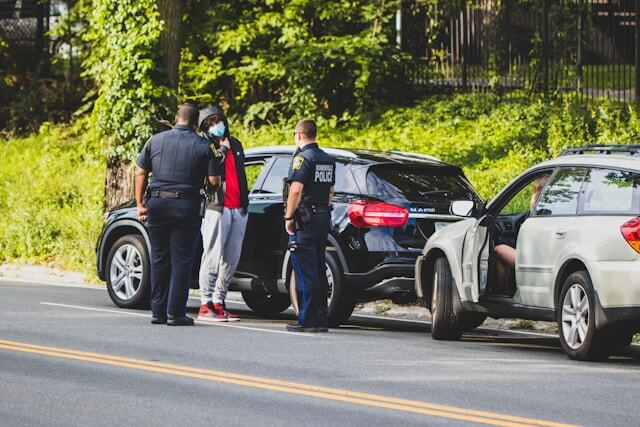
How does uninsured motorist coverage work?
If an uninsured driver is at fault for injuring you or damaging your vehicle, your uninsured motorist coverage will cover the costs that their insurance would ordinarily pay. However, there are some important limitations.
If accident benefits coverage is available, the standard limits will apply as they would for any other accident. You can find these limits in your policy wordings, or in official documentation such as the Statutory Accident Benefits Schedule in Ontario. Accident benefits aren’t really part of uninsured motorist coverage, as they apply to almost any vehicle accident (as long as somebody involved has insurance).
Uninsured motorist coverage mostly exists to cover damages for which the at-fault driver is liable.
These may include pecuniary damages for things like lost wages or property damage, as well as non-pecuniary damages like pain and suffering or emotional trauma. Normally, an at-fault driver’s third-party liability coverage would pay these costs. But, since we’re dealing with an uninsured driver here, they’d have to pay out of pocket. Given that many vehicle-related liability judgments exceed $1 million, the wronged party may not receive even a fraction of what they’re owed. The same applies if the at-fault driver has only the legal minimum level of coverage.
Of course, uninsured motorist coverage isn’t unlimited, either.
Limits of coverage
Your insurance policy always limits coverage for damage to the vehicle’s value, and uninsured motorist coverage is no exception. If your vehicle is damaged by an uninsured driver, your insurer would pay up to the lesser of:
- The cost of repairing the damage
- The vehicle’s actual cash value at the time of the accident
In either case, you’ll usually have to pay a deductible as well. Deductible options vary by province, as do other limitations on the coverage. Generally, the at-fault driver must be identified for damage to your car to be covered. Otherwise, it’s a hit-and-run, which more commonly falls under optional collision coverage.
As an example, let’s look at how it works in Ontario.
Uninsured motorist coverage limits in Ontario
In Ontario, this is known as Uninsured Automobile Coverage. It has other monetary limits, in addition to the repair vs. cash value limitations above:
- The insurer will only pay up to $25,000 (subject to a $300 deductible) for damage to or loss of use of the insured vehicle
- The insurer will never pay more than the minimum limit of liability coverage in the jurisdiction in which the accident occurred ($200,000 in Ontario)1
That second item is important. While $200,000 may seem like a lot, there are many cases where that would not be enough to cover an at-fault driver’s liability for a serious accident. If it were you, you’d want to get everything you were owed if an uninsured driver injured you or a family member. Plus, many jurisdictions (including Quebec and most US states) have minimum limits below $200,000.
Fortunately, in Ontario, Alberta, and Atlantic Canada, you can add an endorsement to your policy known as Family Protection Coverage. This optional add-on increases the coverage limit for uninsured motorist coverage to match your policy’s third-party liability coverage (which should be at least $1 million, if not more). It also applies to hit-and-run accidents, or accidents where the at-fault driver’s insurance is insufficient. This endorsement is inexpensive, and highly recommended.
There is one more important thing to know about limits for uninsured motorist coverage. This applies if your coverage limit is not high enough to cover an at-fault driver’s liability to you. In that case, when both injury and property damage are involved, injury payments have 95% priority.
Example
An uninsured driver hits Sophie’s car, injuring her badly and totaling the vehicle. Sophie has only basic uninsured automobile coverage in Ontario (so, a limit of $200,000). The uninsured driver is found liable for $500,000 in damages — $40,000 for the vehicle, and $460,000 for bodily injury.
Sophie’s car insurance policy will only pay up to the $200,000 limit (the minimum coverage required in Ontario). The payment will be prioritized like so:
$190,000 for bodily injury (95% of $200,000)
$10,000 for damage to her car (5% of $200,000)
In this example, Sophie’s policy covers at least some of the uninsured driver’s liability. That driver would still be responsible for paying, of course, but most people can’t afford to pay hundreds of thousands of dollars — Sophie may never recover what she’s owed. This illustrates why uninsured motorist protection and endorsements like Family Protection Coverage are very much worthwhile.
If you’re uncertain about how your own uninsured motorist coverage works, make sure to review your car insurance policy or speak with your provider.
Commonly asked questions
Is there a deductible for uninsured motorist coverage in Ontario?
Uninsured automobile coverage in Ontario covers both bodily injury and damage to your vehicle caused by an uninsured or unidentified driver. Damage to your car or the contents inside is subject to a $300 deductible.
What happens when you drive without insurance?
Car insurance is mandatory across Canada. An uninsured driver, if caught, will have to pay a hefty fine and likely have their vehicle impounded (at additional cost to them). For example, the fine for driving without insurance starts at $5,000 in Ontario — it’s not worth it.2 On top of that, a citation for driving without insurance can have a major impact on one’s car insurance premiums, and even their ability to qualify for insurance in the first place.
Sources
- Insurance Act. “R.R.O. 1990, Reg. 676: Uninsured Automobile Coverage.” Government of Ontario, www.ontario.ca/laws/regulation/900676. Accessed 22 May 2025.
- “It’s the Law — What You Need To Know.” Financial Services Regulatory Authority of Ontario, fsrao.ca/consumers/auto-insurance/purchasing-your-policy/its-law-what-you-need-know. Accessed 22 May 2025.
Want to learn more? Visit our Car insurance resource centre for dozens of helpful articles. Or, get an online car insurance quote in under 5 minutes and find out how affordable personalized coverage can be.
About the expert: Sunny Dhiman
Sunny has been with Square One since 2017, and presently holds the title of Call Centre Manager. Sunny is responsible for training and coaching new and existing employees. He also advises on complex underwriting, quote, or policy related matters. Sunny has a level 2 general insurance licence in BC, Alberta, Manitoba, and Saskatchewan. He has an OTL licence in Ontario and an AMF licence in Quebec. Sunny is also working on CAIB and CIP designations.