Identity theft insurance

Written by Seamus McKale

Reviewed by Daniel Mirkovic

Updated May 29, 2026 | Published May 29, 2026

Identity theft insurance provides financial protection for people who have been victimized by identity theft or fraud. Identity theft coverage may exist as a standalone policy or an add-on to another insurance policy, especially home insurance.

Precise coverage and limits vary by provider. Generally, identity theft insurance covers things like financial losses, legal fees, administrative costs, lost wages, document replacement, and more — as long as the loss or expense in question is related to recovering from identity theft.

Keep reading to learn how identity theft insurance works, how to get it, and how to protect yourself from identity-related fraud.

A person wearing a black hoodie holds a Canadian $100 bill in front of their face

The important points

  • Identity theft insurance protects the insured from financial losses arising from identity theft and identity fraud.
  • Coverage usually includes legal and administrative fees, financial losses, lost wages, and other associated costs.
  • Identity theft insurance is normally inexpensive and available as an add-on to some home insurance policies, notably those from Square One.

What is identity theft insurance?

Identity theft insurance covers financial losses associated with identity fraud. Standalone policies exist, but identity theft coverage usually takes the form of an add-on to another policy — like homeowner, tenant, or condo insurance.

What are identity theft and identity fraud?

Identity theft and identity fraud are crimes that involve a fraudster stealing someone’s personal information and using it for financial gain. Identity theft is the crime of stealing someone’s personally identifiable information. Identity fraud is the misuse of that information to commit crimes.

Identity theft and fraud are rampant in Canada, with no signs of going away.

In the most recent comprehensive survey, nearly seven percent of Canadian adults reported that they’d been victimized by identity theft — and that was in 2008.1 More recent data is limited to police-reported incidents, which typically represent only a tiny portion of actual incidents. Only about seven percent of identity theft cases are reported to law enforcement.2

Nevertheless, police-reported identity theft cases have been growing more common in Canada for many years.
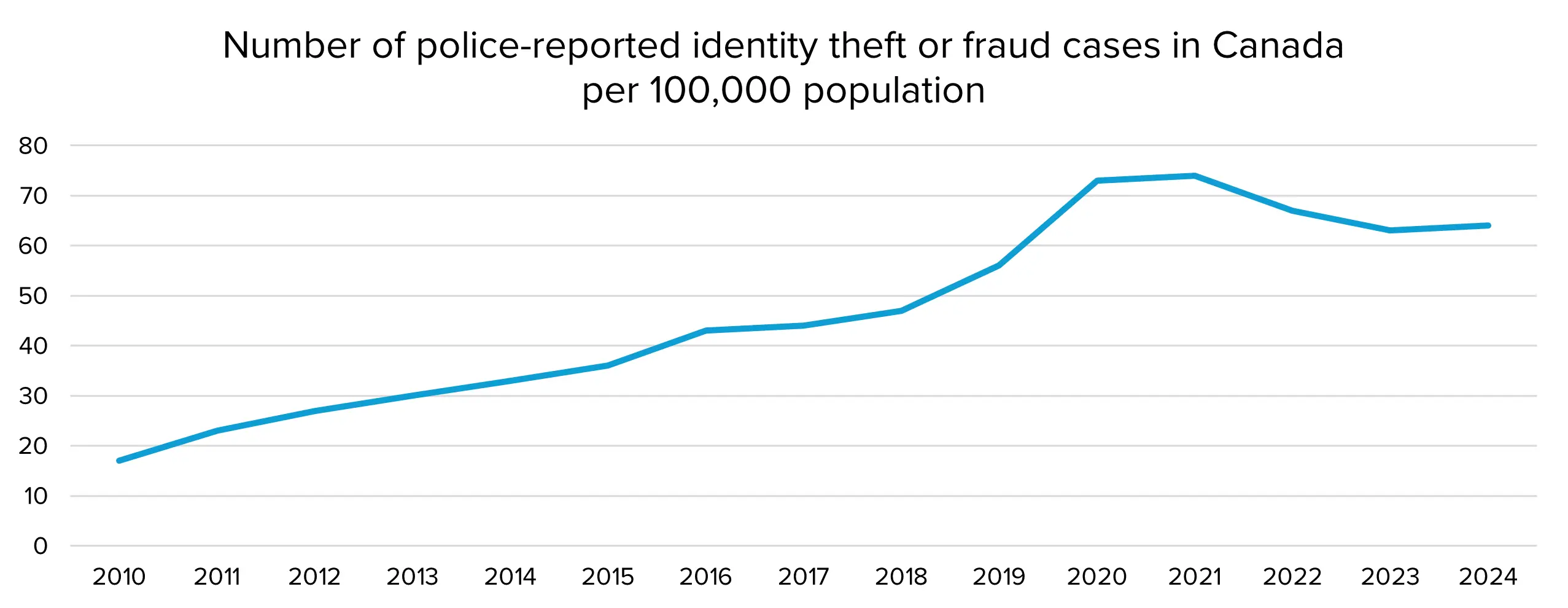
Graph of police-reported identity theft or fraud cases in Canada per 100k population from 2010-2024

Identity fraud takes many forms. Recent examples include:

  • Manitoulin Island, ON: a man was charged with fraud after stealing a victim’s identity and using it for online financial transactions to the tune of $900,000.3
  • New Tecumseth, ON: a victim’s personal information was used to create a fake ID, which was in turn used to take out a credit card in their name and to purchase a luxury vehicle.4
  • Halifax, NS: a retiree had $28,000 stolen directly from his bank account after identity thieves gained access.5
  • Lethbridge, AB: a five-member group was charged after an investigation revealed fraudulent bank accounts, credit cards, and loans taken out with stolen identities.6

As you can see, it’s critical to protect yourself from identity theft. But, with so many fraudsters out there, even a diligent person can fall victim. Luckily, identity theft insurance can help you if preventative measures fail.

What does identity theft insurance cover?

Identity theft insurance is designed to help a victim of identity theft work through the process of recovering their identity.

While every product is different, the coverage usually reimburses the victim for financial losses they incur from identity theft and expenses they incur during the recovery process. Depending on the nature of the theft, those expenses take many possible forms.

Generally, identity theft insurance covers expenses for things like:

  • Legal and administrative fees. It’s often wise to hire a lawyer if you’ve been victimized by identity theft. They can help you navigate the process, deal with credit bureaus and other entities, and help you arrange a civil lawsuit to recover damages (if that’s possible). A lawyer will also defend you if you’re accused of crimes committed with your stolen identity.
  • Professional assistance. Sometimes, a victim may benefit from hiring a case manager or other specialist to help them work through the process.
  • Document replacement. A victim may have to replace any number of documents after having their identity stolen, such as a passport or driver’s licence.
  • Bank fees. Many identity fraud cases result in various charges from the victim’s financial institution.
  • Lost wages. The victim may have to take time away from work to deal with the fallout of identity fraud.

What does identity theft insurance not cover?

Like any insurance policy, identity theft insurance has limitations. For one, it won’t cover any losses or expenses beyond the policy limit.

When you buy the policy, you can usually choose a limit of coverage. For example, Square One offers limits between $10,000 and $50,000.

Aside from that, it’s important to note that some identity theft policies don’t cover the actual financial loss, whether that’s stolen money or fraudulent purchases. These losses are sometimes recoverable through the victim’s financial institution or a lawsuit, but not always.

Identity theft insurance from Square One does cover financial losses that are otherwise unrecoverable, up to the chosen coverage limit.

Related articles

It only takes 5 minutes

ready for an online quote? Your time matters, and so does your stuff. Get a personalized home insurance quote in 5 minutes. That’s less time than it takes to wait in line for coffee.

Before you start, please review our Privacy Policy and Terms of Use.

Is identity theft insurance worth it?

If the price is right, identity theft insurance is absolutely worth it.

Like any form of insurance, you have to weigh your personal risk tolerance against potential losses if you don’t have coverage. Of course, the best thing you can do is prevent losses in the first place with good personal security habits. Nevertheless, even diligent people can find themselves victimized by fraudsters.

Identity theft insurance is particularly worth it if your lifestyle involves certain activities that could increase your risk. That includes:

  • Frequent online shopping at many websites
  • Extensive credit card use, especially multiple credit cards
  • Remote work (away from your home or office)
  • Never or rarely changing passwords, or reusing the same passwords often
  • Infrequent monitoring of your personal credit reports

Some identity theft insurance is very affordable. The cost of identity theft coverage from Square One starts at $1.67 per month, for example. It’s simple to add it to your home insurance policy at any time, or include it in a quote for a new policy.

Commonly asked questions

How do I check if my identity has been stolen?

The best way to know if your identity is stolen is to stay alert and watch for unusual activity.

Monitor your bank and credit card statements regularly. Check your credit report often. Unexplained calls from lenders or collection agencies are another sign that someone is committing fraud with your identity.

What should I do if my identity is stolen?

If you suspect that someone has stolen your identity, report it to the following institutions as soon as possible:

  1. Local police
  2. Your financial institution(s)
  3. The Canada Revenue Agency
  4. The Canadian Anti-Fraud Centre
  5. Credit reporting agencies TransUnion and Equifax

Additionally, get a copy of your credit report. Many banks offer credit report access as a free feature, or you can order a copy from the reporting bureaus.

Document every report you make, as well as all your recent and future financial transactions.7

What’s the difference between identity theft insurance and identity monitoring?

Identity monitoring is a proactive service offered by many institutions, including the major credit bureaus. If you’re subscribed, they’ll send you alerts about suspicious activity on your credit report.

The difference between that and identity theft insurance is that monitoring is a proactive monitoring tool, while insurance is a safety net.

Having both can be beneficial. While neither product prevents identity theft, having both means that you’ll limit the damage if it happens to you and have coverage for the losses you do suffer.

Sources

  1. Reynolds, Dylan. “Everyone is Victimized or Only the Naïve? The Conflicting Discourses Surrounding Identity Theft Victimization.” International Review of Victimology, Vol. 29(3), pp. 449–465, 27 April 2022, doi.org/10.1177/02697580221091284.
  2. Harrell, Erika. “Victims of Identity Theft, 2018.” Bureau of Justice Statistics, NCJ 256085, April 2021.
  3. MacDonald, Darren. “Quebec Man Charged With Identity Theft in $900k Fraud Case in Northern Ont.” CTV News, 10 February 2026, www.ctvnews.ca/northern-ontario/article/quebec-man-charged-with-identity-theft-in-900k-fraud-case-in-northern-ont.
  4. Surbey, Brett. “Ontario Police are Hunting an Identity Fraud Suspect — and it’s a Warning for All Canadians.” Yahoo! Finance, 16 April 2026, ca.finance.yahoo.com/news/ontario-police-hunting-identity-fraud-141500075.html.
  5. MacIvor, Angela. “This Man Lost His Life Savings to Identity Fraud. He Doesn’t Know How it Happened.” CBC News, 8 April 2025, ici.radio-canada.ca/rci/en/news/2154668/this-man-lost-his-life-savings-to-identity-fraud-he-doesnt-know-how-it-happened.
  6. Lethbridge Police Service. “Police Charge Five People in Connection with Identity Frauds, Forging Documents.” lethbridgepolice.ca, 4 February 2025, www.lethbridgepolice.ca/news/posts/police-charge-five-people-in-connection-with-identity-frauds-forging-documents.
  7. “How to Recognize and Protect Yourself From Identity Theft.” ontario.ca, 21 November 2014, www.ontario.ca/page/how-recognize-and-protect-yourself-identity-theft.

Want to learn more? Visit our fraud protection resource centre for dozens of helpful articles. Or, get an online quote in under 5 minutes and find out how affordable personalized coverage can be.

About the expert: Daniel Mirkovic

A co-founder of Square One with 25 years of experience in the insurance industry, Daniel was previously vice president of the insurance and travel divisions at the British Columbia Automobile Association. Daniel has a bachelor of commerce and a Master of Business Administration (MBA) from the Sauder School of Business at the University of British Columbia. He holds a Canadian Accredited Insurance Broker (CAIB) designation and a general insurance license level 3 in BC, Alberta, Saskatchewan, Manitoba and Ontario.

Computer

Get a free quote

Get a personalized online home insurance quote in just 5 minutes and see how much money you can save by switching to Square One.

Get an online quote now

People

Protect your family

Even when you take precautions, accidents can happen. Home insurance is one way to protect your family against financial losses from accidents. And, home insurance can start from as little as $15/month.

Learn more

