Types of mortgage fraud (and how to avoid them)

Written by Seamus McKale

Updated December 11, 2025 | Published December 11, 2025

Mortgage fraud is a collection of financial crimes revolving around mortgages. It may be perpetrated by homeowners seeking an advantage in the mortgage application process, or by unscrupulous third parties seeking to profit.

Though just 0.19% of Canadian mortgages involve fraud as of 2024, the consequences for both victims and fraudsters are serious.1 Fraud drives up costs for lenders and home buyers alike.

In this article, we’ll explain the types of mortgage fraud, how to avoid them, and the consequences for fraudsters caught in the act.

Three small, simple model houses sitting on top of papers showing colourful charts

The important points

  • Mortgage fraud is the name for a collection of financial crimes involving mortgages in some way.
  • Mortgage fraud may involve a legitimate home buyer misrepresenting their mortgage application, or a third-party defrauding the mortgage process for profit.
  • Mortgage fraud is a serious crime that may even result in prison time.

What is mortgage fraud?

Mortgage fraud refers to various schemes that involve mortgages in some way. Broadly, mortgage fraud can be separated into two categories:

  1. Someone legitimately buying a home who misrepresents some aspect of their mortgage application
  2. Someone other than a buyer who attempts to illegally profit from the mortgage process

Examples of mortgage fraud in Canada are wide-ranging. Sometimes, it’s as simple as a home buyer misrepresenting their income or other details to qualify for a larger mortgage than they can afford.

“It’s huge in the mortgage industry,” Equifax’s Carl Davies said to CBC Marketplace. “67 percent of the applications that we find that are tagged by our members as fraudulent are actually related to that kind of misrepresentation.”2

Other times, mortgage fraud gets more complicated — like a third party putting their name on the loan even though they won’t be paying the mortgage or living in the home. Or, someone offering to fabricate documentation to facilitate mortgage fraud in exchange for a fee.

Let’s take a closer look at some of the forms of mortgage fraud seen in Canada.

Types of mortgage fraud

At the most basic level, there are two types of mortgage fraud:

  • Fraud for shelter, which is motivated by a desire to obtain a property.
  • Fraud for profit, which is motivated strictly by financial gain.3

Within these two types are countless schemes, potentially involving anyone from home buyers to realtors to mortgage lenders.

Fraud for shelter

Fraud for shelter is usually straightforward and involves a homebuyer misrepresenting themselves to mortgage lenders.

The goal is generally to qualify for a larger mortgage than they otherwise could, or to get a better interest rate. This is usually accomplished by lying about one’s income or existing debts.

One form of fraud for shelter involves straw buyers. A straw buyer is a third party that applies for the mortgage on behalf of the person actually buying the house. The goal is to get a mortgage for someone who can’t qualify on their own. No matter the arrangement between the straw buyer and the actual buyer, the straw buyer is liable for the mortgage and the payments.

Fraud for shelter isn’t necessarily nefarious; the ongoing housing crisis has led some homeowners to resort to fraud just to compete in a difficult market.4 But, regardless of the motivation, fraud for shelter is still fraud. If it’s discovered, the penalties could include revocation of the mortgage (with immediate repayment required) or even prison time.

Fraud is always illegal, and even seemingly minor instances can lead to prison time and other penalties.

Fraud for profit

Within this category are a wide range of scenarios, usually involving multiple parties. With fraud for profit, the goal is to somehow profit from the mortgage process.

There are many ways to accomplish this, including:

  • The buyer, seller, or a third party inflates the purchase price of a home, securing a larger-than-needed mortgage, and pockets the extra money.
  • A fraudster engages a straw buyer to put their name on a mortgage, then profits by selling the property and cutting out the straw buyer.5
  • Realtors or mortgage brokers offer to help home buyers falsify their mortgage application to get a larger mortgage or better rate, in exchange for a fee.6
  • A mortgage broker pressures clients to go with a specific lender, receiving under-the-table kickbacks in exchange.
  • Criminals purchase properties with illicit cash, effectively laundering the money.4

Other types of mortgage fraud

There are other scenarios in which someone tries to profit illegally from mortgages that aren’t tied to a house purchase.

  • Identity theft. If a fraudster steals a homeowner’s identity, they can attempt to take out an equity loan on that person’s home, making off with the proceeds.
  • Reverse mortgage scams. These scams often involve high-pressure sales tactics from fraudulent private lenders, targeting elderly homeowners.7
  • Bankruptcy fraud. This occurs when someone takes out mortgages knowing they can’t afford them. They may acquire several income-earning properties in this way, using the bankruptcy process to stall foreclosure proceedings.8
  • Foreclosure fraud. Some mortgage scams target homeowners at risk of foreclosure. They may offer a payment consolidation plan that provides up-front cash to cover upcoming mortgage payments. Then, they’ll collect future payments, saying they’re forwarding them to the mortgage lender, but, in fact, are keeping them. Other scams involve the fraudsters acquiring the homeowner’s title to their home.9

Related articles

How to detect mortgage fraud

No matter the form of mortgage fraud, vigilance is the key to detecting it. Keep your eyes open for certain signals that something suspicious might be happening:

  1. Someone is offering you money to use your name in a mortgage application, or offering to do the same for you if you pay them.
  2. You’re encouraged to misrepresent something on a mortgage application.
  3. You’re encouraged to leave information or signature fields blank while doing mortgage paperwork.
  4. You see a mortgage amount that’s significantly higher than the property’s sale price.
  5. A buyer or seller in a real estate transaction discourages you from seeing the property.
  6. You’re asked to use cash at any point in a real estate transaction.
  7. You’re refused copies of any documents throughout the home-buying process.

It only takes 5 minutes

ready for an online quote? Your time matters, and so does your stuff. Get a personalized home insurance quote in 5 minutes. That’s less time than it takes to wait in line for coffee.

Before you start, please review our Privacy Policy and Terms of Use.

How to avoid being a victim

If you suspect you’re involved in a mortgage fraud situation, don’t proceed. Remember, mortgage fraud is a crime — potentially one with a prison sentence.

You can report mortgage fraud to police or the Canadian Anti-Fraud Centre. You can also report it anonymously to Crime Stoppers.

If you have concerns with a mortgage broker, realtor, or other professional, but you don’t think it’s criminal-level behaviour, you can also file a complaint with your province’s regulatory body:

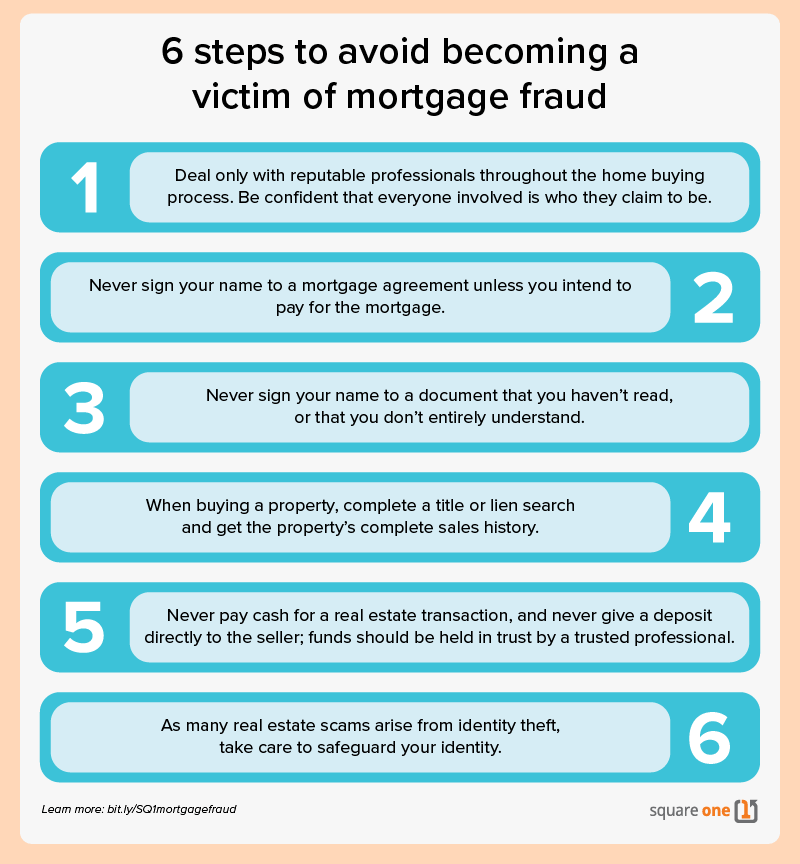
During any real estate transaction, deal only with reputable professionals. And, don’t hesitate to step away and reconsider if you notice anything suspicious. Remember a few basic precautions, like:

  • Be aware of who you’re dealing with, and be confident that everyone is who they claim to be.
  • Don’t put your name on any mortgage agreement unless you intend to pay it.
  • Never sign your name to a document that you haven’t read, or that you don’t understand.
  • If you’re buying a property, complete a title or lien search and get its complete sales history.
  • Never pay cash for a real estate transaction, and don’t give the deposit directly to the seller; funds should be held in trust by a lawyer, notary, or real estate professional.10

And, perhaps most importantly, safeguard your identity. Many real estate scams arise from identity theft.

Commonly asked questions

What is the punishment for mortgage fraud?

The punishment for mortgage fraud depends on the severity, but any level of fraud is a crime. Fraud over $5,000 carries a maximum sentence of 14 years in prison. For fraud under $5,000, the maximum sentence is two years.11

“If you get caught as an accomplice to that fraud, it’s actually a risk of prosecution. It is illegal. Fraud, no matter what, is illegal in Canada,” said Davies.

Depending on the case, fraud can be tried as an indictable offence (more severe) or a summary offence (less severe).

“If you have a prosecution, typically, what will happen is that it will get reported in various places. And those places, lenders will check. You absolutely run the risk of not being qualified for a mortgage. Potentially other financial products too,” said Davies.

In addition to possible prison time and being blacklisted by mortgage lenders, someone found guilty of mortgage fraud may have to pay restitution to the victims or other monetary damages. They could also be tried in civil court.

Does insurance cover mortgage fraud?

There are many forms of mortgage fraud, but, for the most part, there isn’t much insurance coverage available for it. Certainly, someone committing mortgage fraud would have no coverage, as insurance doesn’t cover illegal acts.

Homeowners may have mortgage default insurance or mortgage protection insurance. But these products are intended for situations in which the borrower can’t make their mortgage payments, and not so much for fraud.

Title insurance may cover certain scenarios involving mortgage fraud.

Since many real estate scams start with identity theft, coverage like identity theft insurance from Square One can be helpful in dealing with the situation immediately.

Sources

  1. Mendoza, Candyd. “Mortgage Fraud Cases Decline in 2024.” Canadian Mortgage Professional, 6 March 2025, www.mpamag.com/ca/mortgage-industry/market-updates/mortgage-fraud-cases-decline-in-2024/527448.
  2. “Mortgage Fraud Caught on Camera: Undercover Investigation.” YouTube, uploaded by CBC News, 14 October 2022, www.youtube.com/watch?v=Y_wlnv5ns4I.
  3. Financial Services Regulatory Authority of Ontario. “Detecting and Preventing Mortgage Fraud.” fsrao.ca, 28 September 2023, www.fsrao.ca/industry/mortgage-brokering/regulatory-framework/guidance-mortgage-brokering/detecting-and-preventing-mortgage-fraud.
  4. Field, Cameron. “Fighting Mortgage Fraud in Canada.” Macdonald-Laurier Institute, 13 May 2025, macdonaldlaurier.ca/fighting-mortgage-fraud-in-canada-cameron-field.
  5. Russell, Jennie and Charles Rusnell. “Former Edmonton MLA Carl Benito Set Up ‘Straw Buyers’ Mortgage Fraud, Lawsuit Alleges.” CBC News, 22 August 2018, www.cbc.ca/news/canada/edmonton/benito-straw-buyers-mortgage-fraud-lawsuit-alleges-1.4794023.
  6. Foxcroft, Tiffany, et al. “Real Estate Agents Caught on Hidden Camera Facilitating Mortgage Fraud for a Fee.” CBC News, 14 October 2022, www.cbc.ca/news/business/marketplace-mortgage-fraud-1.6614132.
  7. Taylor, Caitlin, et al. “‘Elaborate Scam’ Leaves Seniors With High-Interest Mortgages They Didn’t Want or Understand.” CBC News, 31 March 2023, www.cbc.ca/news/business/seniors-mortgages-marketplace-1.6795104.
  8. Law Society of Alberta. “Real Estate and Mortgage Fraud.” lawsociety.ab.ca, www.lawsociety.ab.ca/lawyers-and-students/fraud-and-loss-prevention/red-flags/real-estate-and-mortgage-fraud. Accessed 21 November 2025.
  9. Government of Canada. “Real Estate Fraud.” canada.ca, www.canada.ca/en/financial-consumer-agency/services/real-estate-fraud.html. Accessed 21 November 2025.
  10. Canada Mortgage and Housing Corporation. “Mortgage Fraud.” cmhc-schl.gc.ca, 31 March 2018, www.cmhc-schl.gc.ca/consumers/owning-a-home/mortgage-management/mortgage-fraud.
  11. Criminal Code. “R.S.C., 1985, c. C-46.” laws-lois.justice.gc.ca, laws-lois.justice.gc.ca/eng/acts/c-46/section-380.html. Accessed 21 November 2025.

Want to learn more? Visit our Home Buying, Selling and Moving resource centre for everything you need to know about real estate, buying a home, or moving. Or, get an online quote in under 5 minutes and find out how affordable personalized home insurance can be.

Computer

Get a free quote

Get a personalized online home insurance quote in just 5 minutes and see how much money you can save by switching to Square One.

Get an online quote now

People

Protect your family

Even when you take precautions, accidents can happen. Home insurance is one way to protect your family against financial losses from accidents. And, home insurance can start from as little as $15/month.

Learn more