Why do squatters’ rights exist?
Squatters’ rights have existed in some form for centuries.
Before modern surveying techniques and centralized registries, it could be difficult to know with certainty who rightfully owned land. Being able to demonstrate exclusive usage of land for a long time was as strong an argument as any for legal title to that land. Thus, the concept of adverse possession.
As the west of North America was colonized, speculators would snap up massive swaths of land that often went unused. Adverse possession provided a way for people to use such land productively.13
Presently, squatters’ rights in Canada don’t really exist in the way that people think, with most provinces having eliminated adverse possession. Someone occupying a property without the owner’s consent generally does not have a path to gain legal ownership of it.
One modern argument for squatters’ protections is that everyone has to be somewhere.
With unaffordable (and rising) housing costs, many people simply can’t afford accommodation. Thus, many advocate for the right of unhoused people to take up semi-permanent residence on public land.14 Of course, that is different from occupying vacant private property without the owner’s consent.
Preventing squatters from taking over your property
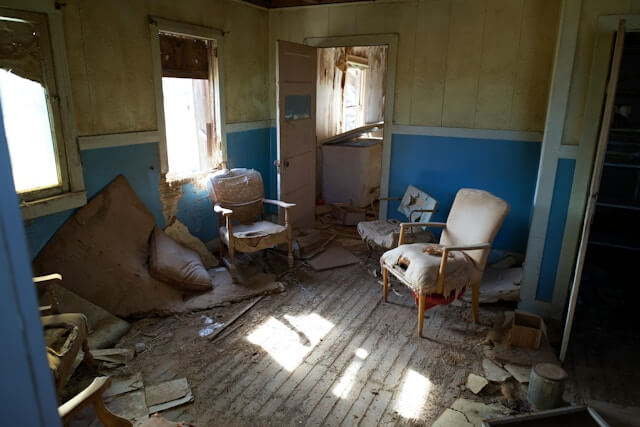
There are several signs that your property could be at risk for squatters. The main sign would be that it’s empty. Vacant homes or seasonal properties are at risk of trespassers, vandals, and yes — squatters.
Whether you’re worried about squatters or not, take steps to protect your unoccupied or vacant properties:
- Check on the property often, or arrange to have someone else do so.
- Prevent break-ins by ensuring all possible access points are locked and sturdy, including doors, windows, large vents, and any other way someone could get inside.
- Make the property look like someone lives there. For example, don’t let newspapers or other mail pile up, and keep up with lawnmowing and other yardwork.
- Install surveillance cameras or a monitored security system.
- Shut off all utilities while the property is not in use.
How to remove squatters legally
If you discover people occupying your unused property illegally, act quickly.
The first step is to order them to leave; if they don’t, they’re trespassing. Maybe you get lucky, and that’s the end of it. But don’t put yourself in harm’s way — provoking a physical altercation is unwise.
Trespassing is a crime. Accordingly, you can (and should) call the police if you’ve given someone notice that they’re trespassing and they refuse to leave.
In cases of overholding tenants, they are not generally considered to be trespassing, as they (at least at some point) were the legal occupants of the property. Instead, you need to follow the correct eviction procedures for your province; only after you’ve secured a legal order can you engage law enforcement to help you remove tenants. It’s never permitted to remove tenants (or their belongings) physically.
Insurance considerations
If you have a vacant property, keep it properly insured.
All home insurance providers require you inform them if a property becomes vacant, because not all are willing to insure vacant homes. It usually costs a little more to ensure a vacant property, as it faces higher risk of loss than one that’s occupied.
Insurers that do cover vacant homes usually impose certain limitations, like higher deductibles or additional exclusions. They may also require that someone periodically check in on the property.
Of course, insurance alone won’t prevent squatters or trespassers on your property. But, the right policy will cover damage from vandalism or mischief provided that the insurer is aware of the property’s occupancy.
In most cases, Square One can offer coverage for homes that become vacant, including vandalism coverage. Our landlord legal protection coverage can help with legal costs associated with obtaining and enforcing a vacant possession order.
Commonly asked questions
What’s the difference between squatting and trespassing?
The primary difference between squatting and trespassing is whether the wrongdoer intends to stay. A squatter is attempting to occupy a property that they have no legal right to occupy, whereas a trespasser is anyone on private land without the landowner’s permission.
“Squatter” is also just a colloquial term; you won’t find it in many laws. Trespassing, meanwhile, is very much a legal concept, with every province having enacted trespassing legislation. Most squatters are either long-term trespassers or overholding tenants (and must be dealt with in different ways).
Can squatters claim abandoned properties?
Squatters can occupy and, eventually, claim ownership of an abandoned property through adverse possession. However, most provinces have eliminated adverse possession for any property with a properly registered title. Where adverse possession claims are possible, there are very specific requirements that must be met to succeed with a claim. For example, continuous occupation for at least 10 years.
Can you sell a property with squatters living in it?
You can sell a property with squatters, whether those are people attempting to occupy a vacant home or overholding tenants. However, you may find it very difficult to do so.
Vacant possession clauses are standard conditions in real estate contracts — it means that the buyer requires the property to have no occupants before the sale proceeds. Sometimes a property is sold with paying tenants remaining, but it’s unlikely you’ll find many buyers for a property with squatters.
Do no trespassing signs help?
A “no trespassing” sign might not deter someone from entering your property, but it does serve a purpose.
Generally, some form of notice is required before someone is considered to be trespassing; someone who genuinely didn’t know they were trespassing can use that as a defence. “No trespassing” signs serve as a clear notice.
However, it’s not necessary to have such a sign. If you ask someone to leave your property and they don’t, they’re trespassing — this includes potential squatters.
Sources
- “Adverse Possession.” novascotia.ca, novascotia.ca/natr/land/policyadversepossession.asp. Accessed 25 July 2025.
- Government of British Columbia. Limitation Act. SBC 2012, c 13, s 28, 14 May 2012, canlii.org/en/bc/laws/stat/sbc-2012-c-13/latest/sbc-2012-c-13.html.
- Government of British Columbia. Trespass Act. RSBC 2018, c 3, s 7, 20 Aug. 2018, canlii.org/en/bc/laws/stat/rsbc-2018-c-3/latest/rsbc-2018-c-3.html.
- Government of Alberta. Property Rights Statutes Amendment Act. SA 2022, c 23, s 1, 15 Dec. 2022, canlii.org/en/ab/laws/astat/sa-2022-c-23/latest/sa-2022-c-23.html.
- Government of Alberta. Trespass to Premises Act. RSA 2000, c T-7, s 5, 1 Apr. 2023, canlii.org/en/ab/laws/stat/rsa-2000-c-t-7/latest/rsa-2000-c-t-7.html.
- Government of Saskatchewan. The Land Titles Act. SS 2000, c L-5.1, s 21, 25 Jun. 2001, canlii.org/en/sk/laws/stat/ss-2000-c-l-5.1/latest/ss-2000-c-l-5.1.html.
- Government of Saskatchewan. The Trespass to Property Act. SS 2009, c T-20.2, s 12, canlii.org/en/sk/laws/stat/ss-2009-c-t-20.2/latest/ss-2009-c-t-20.2.html.
- Government of Manitoba. The Real Property Act. CCSM c R30, s 61, 3 Jun. 2025, canlii.org/en/mb/laws/stat/ccsm-c-r30/latest/ccsm-c-r30.html.
- Government of Manitoba. The Trespass Act. CCSM c T156, s 1, 15 Oct. 2021, canlii.org/en/mb/laws/stat/ccsm-c-t156/latest/ccsm-c-t156.html.
- Government of Ontario. Land Titles Act. RSO 1990, c L.5, s 51.1, 3 Dec. 2024, ontario.ca/laws/statute/90l05.
- Government of Ontario. Trespass to Property Act. RSO 1990, c T.21, s 9, 4 Jun. 2025, ontario.ca/laws/statute/90t21.
- Government of Quebec. Quebec Civil Code. CCQ 1991, c 64, a 2917, 1 May 2014, legisquebec.gouv.qc.ca/en/document/cs/CCQ-1991/20160406.
- Raz, Itzchak T. “Use It or Lose It: Adverse Possession and Economic Development.” Harvard University Department of Economics, Jun. 2018, harvard.edu/files/iraz/files/Raz_UILI.pdf.
- British Columbia Civil Liberties Association. “Squatters’ Rights.” bccla.org, 11 Apr. 2004, bccla.org/resource/squatters-rights.
Want to learn more? Visit our Homeowner resource centre for more articles created specifically to help you navigate homeownership. Or, get an online quote in under 5 minutes and find out how affordable personalized home insurance can be.