How to drive safely around school buses

Written by Seamus McKale

Reviewed by Jil McIntosh

Updated May 5, 2026 | Published May 5, 2026

School buses are one of the safest vehicles someone can travel in. Between 2020 and 2023, just 0.16% of injuries sustained in vehicle collisions in Canada involved school bus occupants.1

Keeping school bus occupants safe is essential. That’s why there are special rules for driving near school buses, and strict penalties for breaking those rules.

In this article, we’ll explain the laws drivers need to know with regards to school bus stops and driving near school buses. Plus, a look at the penalties for breaking these laws in each province and a few safety tips for drivers.

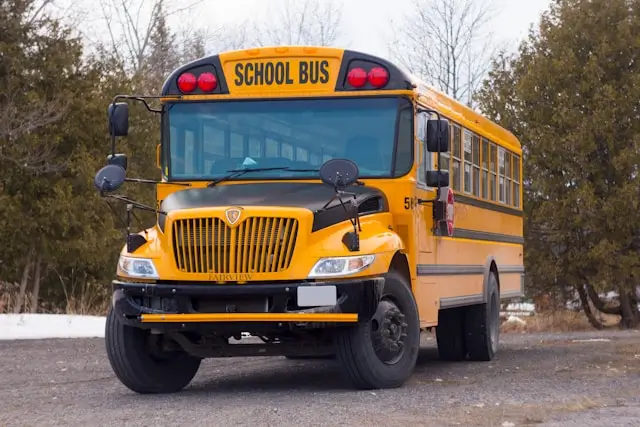
A yellow school bus parked in front of evergreen trees, viewed from the front

The important points

  • Vehicles behind a school bus or approaching from the opposite direction must stop while the bus has its stop sign extended and amber lights flashing.
  • On a roadway separated by a median that traffic cannot cross, vehicles in the opposite direction of the bus do not need to stop.
  • The penalties for failing to stop for a school bus vary by province, but always include a fine and driver’s licence demerit points.

School bus stop laws

The most important law about driving near school buses is that vehicles have to stop when the bus indicates that it’s picking up or dropping off passengers. However, specific rules differ depending on where you’re driving.

In Canada, transportation laws are spread amongst all three levels of government: federal legislation, provincial legislation, and municipal bylaws.2 Laws affecting drivers around school buses are set by federal or provincial governments; municipalities and school districts, meanwhile, may enact rules regarding the bus itself and its occupants, rather than the traffic around the bus.

School buses stop frequently to pick up or drop off children, who may have to cross the road to access the bus. They often stop in spots that don’t have space or infrastructure for such stops, so it’s important for drivers to pay attention near school buses and follow the rules.

“One of the reasons why school bus transportation, as we know, is the safest way for students to get to and from school is because of the number of regulations that surround school buses,” said Dr. Kristin Poland, Deputy Director of the US National Transportation Safety Board’s Office of Highway Safety. “So school buses have to be bright yellow. We know that they are large vehicles. They have required lighting systems on them. There are also very extensive requirements for how the bus is constructed, including roof strength.

“And then there are other rules surrounding how people operate vehicles around the school bus.”3

Recognizing school bus signals

Every school bus is equipped with flashing amber and red lights, as well as one or more folding stop signs on the driver’s side.

When the bus is about to stop to let students on or off, its amber lights will begin flashing. When the amber lights are flashing, drivers should prepare to stop. This includes drivers behind the bus or approaching from the opposite direction, unless there is a road median (as we’ll explain later).

Once the bus has stopped, the red lights will flash, and the stop sign will extend. All school buses across Canada are required to use flashing lights and stop signs.4

Drivers behind and opposite a school bus must stop when the bus flashes its amber or red lights and extends the stop sign. They must remain stopped until the flashing red lights are turned off and the stop sign is retracted.

In some cases, it’s possible the bus driver may temporarily stay put after letting kids on or off. Providing the flashing lights are off and the sign is retracted, you may pass the bus if the road ahead is clear. Be very aware of your surroundings and take extra precaution that there are no pedestrians hidden by the bus.

While you have to stop for a school bus, how far behind or ahead of it depends on your province. For example, you must stop five metres away in some provinces including Saskatchewan, Quebec, and British Columbia. Drivers must stop 20 metres away in others, including Ontario, Nova Scotia, and New Brunswick. Know the distance requirement in your province.

Once it’s safely stopped, the bus will let students on or off. Some students may cross the road at this time. That’s why traffic in both directions must stop — and remain stopped until the bus driver has shut off the flashing lights and retracted the stop sign. Drivers may then proceed, but need to pay extra attention to students who may still be in the area.

The only exception when stopping for a school bus is when the road is divided by a median — a physical barrier between traffic directions, such as a wall, or a concrete or grass strip that traffic cannot cross. In this case, traffic coming toward a bus on the opposite side of the median doesn’t have to stop. Traffic travelling in the same direction as the bus has to stop.5 6

Related articles

Provincial penalties for failing to stop for a school bus

Like many traffic violations, the consequences for failing to stop for a school bus vary by province. But no matter where you are, you can expect to pay a serious fine and receive a few demerit points on your driver’s licence. In most cases, repeat offenses result in greater penalties.

Province Fine Demerit points
British Columbia7 8 $368 3
Alberta9 $567 6
Saskatchewan10 11 $360 4
Manitoba12 13 $672 -2
Ontario5 $500 – 2,000 6
Quebec14 $200 – 300 9

Tips to safely drive around a school bus

Whether driving near a school bus or passing through a school zone, drivers should be especially vigilant and follow these safety tips:

In school zones

  • Drive slowly, strictly obeying the posted school zone speed limit (usually 30 km/h).
  • Stop for crossing guards, and obey their directions.
  • Avoid overtaking other vehicles, U-turns, and other maneuvers that children and other drivers may find unpredictable.
  • When stopping at a crosswalk, stop behind the stop line — don’t encroach into the crosswalk or intersection.
  • Avoid distracted driving (even more so than usual).

Near school buses

  • Be prepared to stop at any time, and leave yourself plenty of time and space to do so.
  • Know your province’s required distance when stopping in front of or behind a school bus, which leaves children enough space to cross the road if necessary. When in doubt, stop farther back rather than closer.
  • Don’t move your vehicle until the bus driver has shut off the flashing lights and retracted the stop sign, and you’ve confirmed it’s clear to proceed.
  • Pay extra attention after a school bus stop. You know for a fact there are children nearby at that time.
It only takes 5 minutes

ready for an online quote? Your time matters, and so does your car. Get a personalized car insurance quote in 5 minutes. That’s less time than it takes to wait in line for coffee. Car insurance is available in Ontario and Quebec.

Before you start, please review our Privacy Policy and Terms of Use.

Insurance considerations

Like any driving conviction, a ticket for failing to stop for a school bus will almost certainly result in an increase in your car insurance premiums when your policy renews. A ticket like this may be considered a major conviction, and many insurance providers won’t insure drivers who have recently received such a conviction.

So, in addition to a hefty fine, you may find yourself seeking a new insurance policy if you don’t drive safely around school buses.

Commonly asked questions

What happens if you don’t stop for a school bus?

The penalty for failing to stop for a school bus varies by province, but generally it includes a fine of at least $300 and multiple demerit points on a driver’s licence.

How far behind a school bus with flashers on should you stop?

Depending on where you’re driving, the provincial regulation may require you to stop between five metres (one car length) to 20 metres (four to five car lengths) behind a school bus with lights flashing and its stop sign extended. Know your province’s rules, but also be prepared to stop farther back if it’s safer.

Are there exceptions to stopping for a school bus?

The only exception to stopping for a school bus is if the bus is on the opposite side of a road divided by a median that vehicles cannot cross. The median could be a concrete barrier, a grass strip, or another separator, but there must be a complete physical separation between the two directions of traffic.

How do you report someone failing to stop for a school bus?

If there’s been an incident resulting in injury or property damage, call 9-1-1.

If you’ve witnessed a driver fail to stop for a school bus but no harm was done, you can report it to your local police service’s non-emergency line. Some services, like the RCMP and the Ontario Provincial Police, have online reporting tools for traffic complaints and other non-emergencies.

Have the offending vehicle’s licence plate number and a description of it ready when you make the report.

What is the “danger zone” around a school bus?

The danger zone of a school bus is the area directly around the bus where the driver may not be able to see people standing. The zone extends about ten steps from the bus in all directions.15 Children riding are taught to avoid this area as much as possible.

Sources

  1. Transport Canada. “National Collision Database.” wwwapps2.tc.gc.ca, wwwapps2.tc.gc.ca/saf-sec-sur/7/ncdb-bndc/p.aspx. Accessed 17 December 2025.
  2. Klar, Lewis N. “Traffic Law in Canada.” The Canadian Encyclopedia, 7 February 2006, thecanadianencyclopedia.ca/en/article/traffic-law.
  3. “School Bus Safety Week.” Behind the Scenes @ NTSB, 21 October 2019, safetycompass.wordpress.com.
  4. Transport Canada. “Safety Standards for School Buses.” tc.canada.ca, 24 May 2019, tc.canada.ca/en/road-transportation/school-bus-safety/safety-standards-school-buses.
  5. “Stopping for School Buses.” ontario.ca, 18 January 2021, ontario.ca/document/official-ministry-transportation-mto-truck-handbook/stopping-school-buses.
  6. CAA Staff. “Important Reminder for Drivers: Always Stop for School Buses.” CAA Magazine, 8 August 2018, caamagazine.com/on/safety/important-reminder-for-drivers-always-stop-for-school-buses.
  7. Offence Act. “B.C. Reg. 89/97, Schedule 3.” bclaws.gov.bc.ca, bclaws.gov.bc.ca/civix/document/id/complete/statreg/89_97_04. Accessed 17 December 2025.
  8. Insurance Corporation of British Columbia. “Fines and Points for B.C. Traffic Offences.” icbc.com, icbc.com/driver-licensing/tickets/fines-points-offences. Accessed 17 December 2025.
  9. Student Transportation Association of Alberta. “FAQ.” staa.ab.ca, staa.ab.ca/faq. Accessed 17 December 2025.
  10. Michaels, Hayden. “Tips Regarding Bus Safety for Motorists from SGI.” Swift Current Online, 6 September 2024, swiftcurrentonline.com/articles/tips-regarding-bus-safety-for-motorists-from-sgi.
  11. SGI. “Safe Driver Recognition Discounts and Penalties.” sgi.sk.ca, sgi.sk.ca/sdr. Accessed 17 December 2025.
  12. Manitoba Public Insurance. “MPI and River East Transcona School Division Team Up During School Bus Safety Week.” mpi.mb.ca, 23 October 2025, mpi.mb.ca/mpi-and-river-east-transcona-school-division-team-up-during-school-bus-safety-week.
  13. Driver Safety Rating Input Factor List. apps.mpi.mb.ca, apps.mpi.mb.ca/DriverSafetyRating/Search.aspx. Accessed 17 December 2025.
  14. Société de l’assurance automobile du Québec. “Your Obligations Around Schools.” saaq.gouv.qc.ca, saaq.gouv.qc.ca/blob/saaq/documents/publications/feuillet-obligations-around-schools-school-buses.pdf. Accessed 17 December 2025.
  15. “School Bus Safety.” ontario.ca, 7 December 2021, ontario.ca/page/school-bus-safety.

Want to learn more? Visit our vehicle owner resource centre for dozens of helpful articles. Or, get an online car insurance quote in under 5 minutes and find out how affordable personalized coverage can be.

About the expert: Jil McIntosh

Jil McIntosh writes professionally about a variety of automotive subjects, and has contributed to such publications as Driving.ca, AutoTrader.ca, Automotive News Canada, Old Autos, Toronto Star Wheels, and more. A member of the Automobile Journalists Association of Canada (AJAC), she has won numerous awards for her writing, including Automotive Journalist of the Year.

Computer

Get a free quote

Get a personalized online home insurance quote in just 5 minutes and see how much money you can save by switching to Square One.

Get an online quote now

People

Protect your family

Even when you take precautions, accidents can happen. Home insurance is one way to protect your family against financial losses from accidents. And, home insurance can start from as little as $15/month.

Learn more

