Window tint laws in Canada: a comprehensive guide

Written by Ziyad Bakkali

Reviewed by Jil McIntosh

Updated September 19, 2025 | Published September 18, 2025

You’ve probably seen them before — cars with windows so dark you can barely see inside. Maybe you’ve even thought about tinting your own, whether to block out the sun or for extra privacy. But what do Canadian laws have to say about tinting your windows?

Like any vehicle modification, aftermarket window tinting has restrictions — specifically on how dark the tint can be and which windows you can tint.

In this guide, we’ll explain how tint levels are measured and break down the laws by province so you know exactly how to keep your car windows street legal.

A black and white photo showing the side profile of a glossy black luxury sedan on a paved stone floor, with light from above illuminating its sleek, curved silhouette

The important points

  • Window tinting rules in Canada are set provincially.
  • While most provinces and territories heavily restrict aftermarket tints on the windshield and front side windows, they generally don’t have any specific limits on how dark the rear side and back windows can be.
  • If you’re caught driving with illegally dark tints, you could face fines and potentially receive an order to remove the film.

Understanding window tints and tint levels

Window tinting refers to the process of darkening vehicle glass — essentially, adding a “tint”. There are two main kinds of window tints:

  • Factory tint: These are dyes or pigments infused into the glass during the manufacturing process. Factory tints are not removable (unless you replace the whole window).
  • Aftermarket tint: This is a thin laminate film added to a window after the vehicle has left the manufacturing facility. The film is often dye-based, but it can also be made of metal, carbon, or ceramic particles. Unlike factory tints, these can be removed, replaced, and even customized.

Though both types alter the glass’ appearance (to some degree), aftermarket tints come with a greater range of options. For example, they can offer different levels of durability, light transference, heat rejection, and UV protection. Of all these features, Canada’s automotive window tint laws primarily focus on Visible Light Transmission (VLT).

Put simply, VLT is the percentage of visible light that passes through glass. When tint is applied to a car’s window, VLT measures the amount of light that can pass through that tinted glass. The amount of light passing through dictates how light or dark the window appears (and thus, how well you can see through it).

In essence, a window tint with 100% VLT allows all the incoming light to pass through, making the glass appear crystal-clear. A tint with 0% VLT blocks all the incoming light, making it virtually impossible to see in or out. You can measure VLT using a tint meter.

Permissible factory tint on a vehicle’s windshield, in all provinces, must allow at least 70% of light to pass through — a minimum of 70% VLT.1

By contrast, aftermarket window tints are provincially regulated (as are any other modifications you make to your vehicle). Let’s break down how they differ across Canada.

Note that in virtually all cases, if the read window has dark tint, it is only legal if the vehicle has exterior side mirrors on both the left and right sides. This won’t be a problem on newer vehicles, but could be an issue on classic cars that may only have one for the driver’s side.

Window tint laws by province

Every province has its own laws when it comes to automotive window tints. Make sure you know what’s legal in your region — it’s the best way to avoid unnecessary trouble with the police.

In most provinces, reflective tints are forbidden. Reflective tints have a shiny, mirror-like finish that bounces back more light and glare than non-reflective tints. That glare can reflect into the eyes of other drivers, making it a potential safety hazard. Manitoba is the only province that allows reflective tints, but they must not reflect more than 35% of light, and they can only be used on the side windows, not on the windshield or rear window. Elsewhere, it’s best to avoid them altogether.

Before we break down the laws, here’s a handy visual to help you know which window is which, just to make referencing easier:
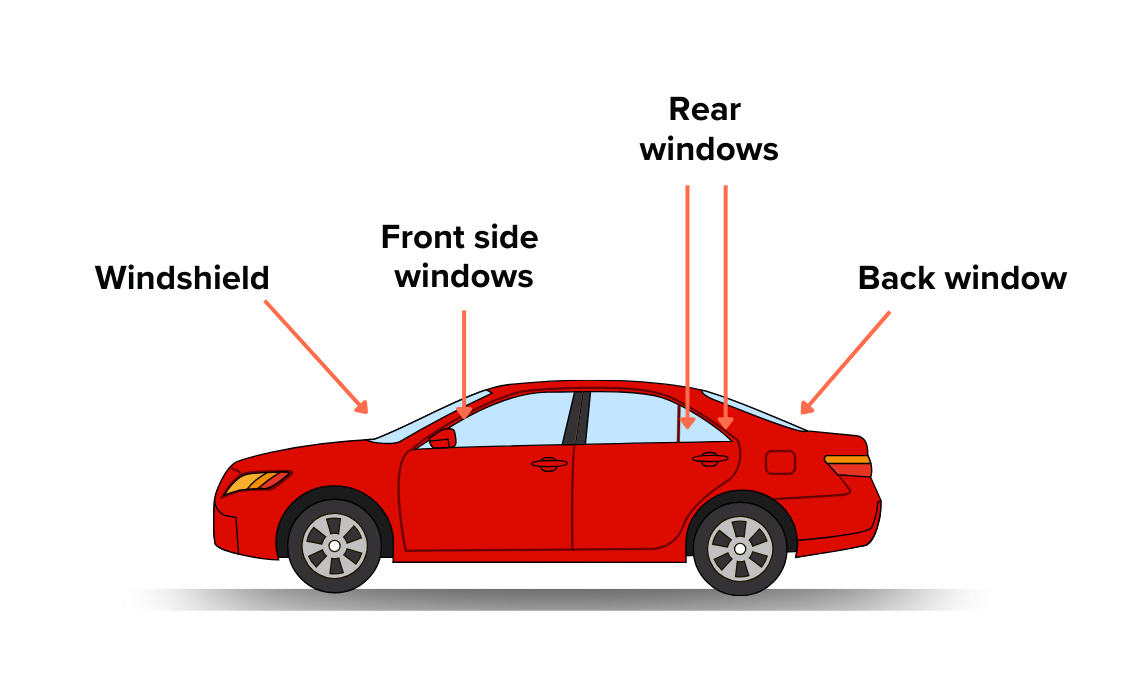
A side-view illustration of a standard passenger car with its main window areas labeled

Alberta

In Alberta, aftermarket tints are strictly prohibited on the windshield and front side windows.2

There are no restrictions for the rear side windows and back window.

British Columbia

In BC, windshields cannot be tinted beyond the top 75 millimeters (3 inches) of the glass. Driving with any tint on the front side windows is illegal.3

However, there is no limit for darkening the backseat windows and the back window.

Manitoba

In Manitoba, a vehicle’s windshield can only have tint applied to the top 127 millimeters (5 inches) of the glass or added by the glass manufacturer. The upper band can be a uniform or graduated tint, depending on preference.

If the band is a uniform shade, it must offer a minimum of 25% VLT. If the band is a gradient, the upper 64 millimeters (2.5 inches) cannot offer less than 5% VLT, and the remainder must offer 25% or higher.

Driver and passenger side windows must allow at least 50% of incoming light through.4

The backseat and back windows have no tinting restrictions.

Ontario

Ontario’s Highway Traffic Act states that no one can drive a vehicle if:

“…the surface of the windshield or of any window to the direct left or right of the driver’s seat has been coated with any coloured spray or other coloured or reflective material that substantially obscures the interior of the motor vehicle when viewed from outside the motor vehicle.”5

Put simply, while there’s no official darkness limit for the windshield and front side windows, they can’t “substantially obscure” your view. Whether it crosses the line would ultimately be up to the police officer, who may then order a mandatory inspection.

Within Ontario’s Vehicle Inspection Standard handbook, there are more specific criteria for when a tint may be considered illegal:6

  • There’s aftermarket tint on the windshield of any vehicle manufactured after January 1, 2017.
  • The tint extends more than 75 millimeters (3 inches) from the top edge of the windshield or below the AS line. This is the point on the windshield, usually indicated by a small arrow or mark on the glass, which indicates the limit of the area that can be tinted at the top of the windshield.
  • The windshield or front seat windows allow less than 70% of light through.
  • The windshield and front side glass windows on which any tint is applied are not original equipment manufacturer (OEM) branded.

Like most provinces, Ontario doesn’t have specific regulations for how dark tints on the rear side windows and back window can be.

Saskatchewan

Saskatchewan laws do not allow aftermarket windshield tints, except on the portion extending 75 millimeters (3 inches) below the top edge. Tints on the front side windows are prohibited.

There are no tint restrictions for windows behind the driver.7

Quebec

In Quebec, tinting can only be applied to the top 150 millimeters (6 inches) of the windshield; otherwise, no material or coating is allowed. Front side windows can only be equipped with aftermarket tints offering 70% VLT or higher.

Again, there are no limits for the rear side windows or the back window.8

Atlantic Canada

Tint laws in Newfoundland and Labrador, Nova Scotia, and Prince Edward Island are the same: no aftermarket tints are allowed on the windshield and front side windows, but any tint can be applied to the windows behind the driver.9 10 11

New Brunswick is the only province in Canada that allows aftermarket tints on the entire windshield. Any windshield tint applied must not block more than 30% of light, or must offer at least 70% VLT. The same applies to front side windows, which must also offer 70% VLT.12

In all these provinces, there are no tint restrictions on the rear side windows or back window.

The territories

In Nunavut and the Northwest Territories, aftermarket tints are not allowed on any window forward of the driver. Like most provinces, there are also no restrictions on the backseat windows and back window.13 14

Yukon’s window tint laws are slightly ambiguous. The Motor Vehicles Act itself mentions nothing about tints specifically. The only guidance on what is acceptable is a 2021 statement from Yukon RCMP, which clarifies that up to 30% tint (or a minimum 70% VLT) is allowed on the windshield, front seat windows, and the rear window.15 There’s no precise regulation for the backseat windows, so the level of tint is generally unrestricted.

Even so, Yukon’s laws prohibit any window obstruction that could make driving unsafe. So, tint with caution.

It only takes 5 minutes

ready for an online quote? Your time matters, and so does your car. Get a personalized car insurance quote in 5 minutes. That’s less time than it takes to wait in line for coffee. Car insurance is available in Ontario and Quebec.

Before you start, please review our Privacy Policy and Terms of Use.

What are the penalties for illegal tints?

Despite regulations everywhere, many drivers still choose to install illegal window tints on their vehicles. Seemingly enough, police tend to focus on the more serious traffic offences first, which can make illegal tints seem like a low-priority issue. But sooner or later, those windows are likely to get you pulled over.

If your tint is darker than allowed, the police can issue a ticket. The fine varies by province and whether you’ve been caught with illegal tint before, but it can generally range from $85 to $600. When you are fined for a window tint violation, it goes on your driving record — you won’t get any demerit points for it, though.

The officer may also issue a notice of inspection — basically an order to remove or replace the tint and pass an inspection before it can be legally driven again. If you’re pulled over again with illegal tints and the officer finds you haven’t complied with the inspection, further fines and even impoundment can happen.

On a related note, window tint rules also follow you across provincial borders. Canada doesn’t have a country-wide tinting standard, so your windows must still meet the laws of the province you’re driving into.

Insurance implications

Insurers rely on your driving record (along with other factors) to assess your risk level and calculate your car insurance premiums. How much (and whether) that risk impacts your rates will depend on how it’s weighted in your insurer’s pricing equation.

In some cases, you may run into issues when trying to purchase a new policy or switch providers. If an insurer requires a vehicle inspection as a condition of offering coverage, and the inspector finds non-compliant tinting, the insurer could decline your application or issue the policy only after you’ve paid to remove the tint. Again, it all depends on how the company filed its rules.

As for car accidents, impaired visibility due to illegal tinting could potentially factor into your claim settlement. Depending on the province, it could be argued that your illegally darkened windows prevented you from seeing the other car (or another road user, like a cyclist or pedestrian). Your insurer would still cover the compensatory damages for which you’re liable, but they may adjust the settlement if the non-compliant tints contributed to an injured third party or led to litigation.

Pros and cons of window tints

There’s a reason why so many drivers opt for tinted windows:

  1. They add an extra layer of privacy — it’s harder for people to peek through your windows, which in effect also helps deter car thieves from eyeing valuables inside.
  2. Many drivers also love the sleek, polished look that tints give the car’s exterior.
  3. High-quality tints have been shown to reduce in-cabin temperatures by up to 5°C.16
  4. On hot sunny days, the tint can help block UV rays that would damage the interior upholstery.
  5. Tints reduce glare from bright sunlight and headlights, too, making driving a little easier on your eyes. If a tinted window ever breaks, the adhesive film can help hold shattered glass together.

However, tinting isn’t all upside:

  1. Extra-dark tints can make windows hard to see through from the inside, especially at night. If you need to merge, check your blind spots, or parallel park, the limited visibility can make it tougher to gauge what’s around you, including pedestrians and cyclists.
  2. If you’re used to glancing through the windows to check for forgotten items, dark tints will make it harder to spot things — you might not notice your keys are still inside the car, for example.
  3. Inside the car, you’ll want to be careful not to scratch or nick the film; something as simple as a seatbelt snapping back against the glass can leave a noticeable tear.
  4. The installation and quality of the tint are important. Cheap tint can bubble or fade into an unpleasant purple hue, and a poor installation can ruin the look altogether.
  5. If you get in a collision in the same (or another) jurisdiction and the tinting is not legal, it may, in some cases, affect how your insurance provider deals with the claim.

Commonly asked questions

How do you measure window tint?

Window tint is measured with a handheld device known as a tint meter. It clamps onto the window and shines a beam of light through the glass to measure how much light makes it to the other side. The reading, shown as a percentage, indicates the visible light transmission (VLT). Some tint meters also display other readings, like ultraviolet rejection (UVR) and infrared radiation (IRR).

These devices are commonly used by police officers and during vehicle inspections to check if a tint meets the legal requirements.

How do you remove window tints?

It’s usually best to have a professional handle tint removal to avoid damaging the glass or defroster lines. The cost will depend on your type of vehicle and the tint film’s condition, but you can expect to pay around $100-$400 for the removal service.17

If you’d rather remove the tints yourself, the first step is to soften the film adhesive with heat. Use a hair dryer or heat gun and slowly move it across the tinted area. As the film warms up and loosens, use a sharp blade or plastic scraper to lift a corner. Then, gently pull the tint away, keeping steady tension to avoid tearing. Once you’re done, there may be some leftover adhesive residue on the glass; you can clean this with a microfiber cloth and either soapy water or an ammonia-based adhesive remover.

Consider watching a quick how-to video before you start, especially if it’s your first time.

Does Canada offer window tinting exemptions?

In most provinces, there is generally no mention of any exemptions that would allow drivers to tint their windows beyond the legal limits.

However, there is a medical exemption program for Albertans. If someone has a physical or medical condition that requires them to avoid sunlight exposure, they may apply for a permit to be exempted from the province’s window tint restrictions. If approved, eligible drivers can install clear ultraviolet window tinting film with a combined VLT of 50% or more.18

Sources

  1. Tchir, Jason. “I see cars with tinted windows so dark you can’t tell if anyone is driving. Is that legal?” The Globe and Mail, 5 Feb. 2023, theglobeandmail.com/drive/mobility/article-i-see-cars-with-tinted-windows-so-dark-you-cant-tell-if-anyone-is.
  2. Government of Alberta. “Traffic Safety Act: Vehicle Equipment Regulation.” Alberta King’s Printer, 2009, kings-printer.alberta.ca/documents/Regs/2009_122.pdf.
  3. Government of British Columbia. “Motor Vehicle Act Regulations.” bclaws.gov.bc.ca 1 Apr. 2013, bclaws.gov.bc.ca/civix/document/id/loo92/loo92/26_58_00.
  4. Government of Manitoba. “The Highway Traffic Act C.C.S.M. c. H60” web2.gov.mb.ca, 19 Feb. 2019, web2.gov.mb.ca/laws/regs/current/_pdf-regs.php?reg=31/2019. Accessed 21 Aug. 2025.
  5. Government of Ontario. “Highway Traffic Act, R.S.O. 1990, c. H.8.” ontario.ca ontario.ca/laws/statute/90h08.
  6. Government of Ontario. “Passenger / Light-Duty Vehicle Inspection Standard.” ontario.ca, Oct. 2015, ontario.ca/files/2022-03/mto-passenger-light-duty-vehicle-inspection-standard-en-2022-03-18.pdf.
  7. Government of Saskatchewan. “The Vehicle Equipment Regulations, 1987, RRS c V-2.1 Reg 10.” canlii.org, canlii.org/en/sk/laws/regu/rrs-c-v-2.1-reg-10/latest/rrs-c-v-2.1-reg-10.html. Accessed 21 Aug. 2025.
  8. Société de l’assurance automobile du Québec. “Tinted windows.” saaq.gouv.qc.ca, saaq.gouv.qc.ca/en/handcrafted-modified-rebuilt-vehicle/tinted-windows. Accessed 21 Aug. 2025.
  9. Government of Newfoundland and Labrador. “Licensing and Equipment Regulations under the Highway Traffic Act O.C. 96-211.” assembly.nl.ca/, 2023, assembly.nl.ca/legislation/sr/regulations/rc961007.htm.
  10. Government of Nova Scotia. “Standards of Vehicle Equipment Regulations.” novascotia.ca, novascotia.ca/just/regulations/regs/mvstdsve.htm. Accessed 21 Aug. 2025.
  11. Government of Prince Edward Island. “Highway Traffic Act.” princeedwardisland.ca, princeedwardisland.ca/sites/default/files/legislation/h-05-highway_traffic_act.pdf. Accessed 21 Aug. 2025.
  12. Government of New Brunswick. “Motor Vehicle Act c M-17.” laws.gnb.ca, laws.gnb.ca/en/showfulldoc/cs/M-17. Accessed 22 Aug. 2025.
  13. Government of Nunavut. “Traffic Safety Act, RSNWT (Nu) 1988, c M-16.” canlii.org, canlii.org/en/nu/laws/stat/rsnwt-nu-1988-c-m-16/latest/rsnwt-nu-1988-c-m-16.html.
  14. Northwest Territories Government. “Motor Vehicle Equipment Regulations R.R.N.W.T. 1990, c.12.” justice.gov.nt.ca, September 15, 1992, justice.gov.nt.ca/en/files/legislation/motor-vehicles/motor-vehicles.r11.pdf.
  15. Plonka, Gabrielle. “RCMP warn against upward trend of tinted windows.” Yukon News, 27 Jan. 2021, yukon-news.com/news/rcmp-warn-against-upward-trend-of-tinted-windows-7000468.
  16. Nasir, Faiza and Jasni, M. Ashraf. “Experimental comparison study of the passive methods in reducing car cabin interior temperature.” ResearchGate, Feb. 2012, researchgate.net/publication/266136337_Experimental_comparison_study_of_the_passive_methods_in_reducing_car_cabin_interior_temperature.
  17. RM Window Tint. “Window tint removal cost.” rmwindowtint.com, 3 Jan. 2025, rmwindowtint.com/blogs/window-tint-removal-cost/.
  18. Government of Alberta. “Vehicle window tint exemption.” alberta.ca, alberta.ca/vehicle-window-tint-exemption. Accessed 26 Aug. 2025.

Want to learn more? Visit our vehicle owner resource centre for dozens of helpful articles. Or, get an online car insurance quote in under 5 minutes and find out how affordable personalized coverage can be.

About the expert: Jil McIntosh

Jil McIntosh writes professionally about a variety of automotive subjects, and has contributed to such publications as Driving.ca, AutoTrader.ca, Automotive News Canada, Old Autos, Toronto Star Wheels, and more. A member of the Automobile Journalists Association of Canada (AJAC), she has won numerous awards for her writing, including Automotive Journalist of the Year.

Computer

Get a free quote

Get a personalized online home insurance quote in just 5 minutes and see how much money you can save by switching to Square One.

Get an online quote now

People

Protect your family

Even when you take precautions, accidents can happen. Home insurance is one way to protect your family against financial losses from accidents. And, home insurance can start from as little as $15/month.

Learn more
