What’s the best anti-theft device for your car?

Written by Seamus McKale

Reviewed by Jil McIntosh

Updated December 3, 2025 | Published November 12, 2025

Almost every vehicle has some type of security system, even if it’s just the standard factory alarm that makes a lot of noise and doesn’t do much else.

But which type of anti-theft system is the best for protecting your car?

Here, we compare the most common types of car security systems available and look at the pros and cons of each.

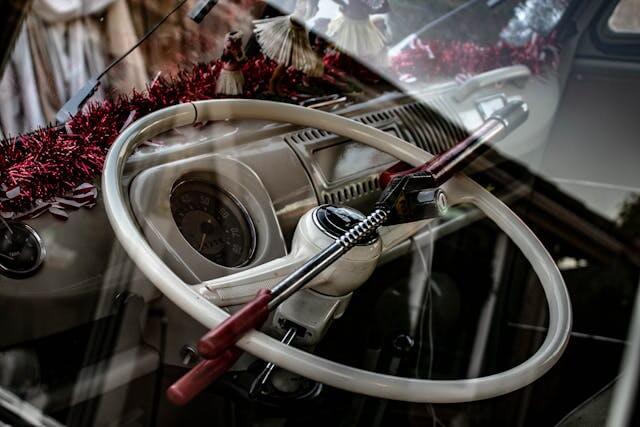
Thumbnail showing a club lock installed on the steering wheel of a classic car, viewed through the driver's side window

The important points

  • No anti-theft device is perfect; it’s best to layer multiple security systems and methods.
  • Many factory-installed security systems are ineffective, and most vehicles benefit from the addition of one or more aftermarket anti-theft devices.
  • Most car insurance providers offer a range of discounts for anti-theft devices.

Understanding car security systems

A car security system detects attempted break-ins and sounds an alarm.

Some security systems are more advanced than others. Everyone knows the horn-honking, headlights-flashing car alarm that’s standard on almost every modern vehicle.

Standard car alarms usually have these components:

  • Sensors, which can include switches in the doors, pressure sensors, motion detectors, perimeter scanners, tilt detectors, and more.
  • An audible alarm, which might honk the vehicle’s horn, or use a separate noise-generating device.
  • A radio transmitter, which allows the owner to control the system through the key fob.
  • A battery, allowing the alarm to function even if the vehicle’s main battery is dead or disconnected.
  • A control unit, basically the brain of the alarm, takes in sensor input and tells the other components what to do.1

Unfortunately, audible alarms on their own don’t seem to prevent much theft.2 Luckily for car owners, there are other, better theft protection options available.

Related articles

The most effective theft prevention strategy involves multiple layers of protection. For example:

  1. Simple, non-mechanical theft prevention, like parking in secure areas and ensuring you actually lock the car doors when you leave.
  2. Visible theft deterrents, like steering wheel locks or VIN etching.
  3. Reactive car alarms (the typical noisemaking kind).
  4. Engine immobilizers, which disable the vehicle’s ignition.
  5. Tracking systems, which aid in recovering a vehicle after it’s been stolen.

In the next section, we’ll review some of the best systems and devices for protecting against car theft, as well as how to select the right anti-theft device for your needs.

No single anti-theft system is completely effective; the best way to protect your car is with layers of different types of protection.

The best anti-theft devices for cars

Most modern vehicles come equipped with various theft deterrents. Nevertheless, there are many aftermarket anti-theft devices to consider, from simple physical deterrents to advanced tracking systems.

Remember: you don’t have to choose just one. The best deterrent to car theft is a layered approach.

Steering wheel locks

Steering wheel locks (a.k.a. club locks) are a common, well-known anti-theft device. They’re inexpensive, and at least somewhat effective. While they aren’t that difficult for a thief to overcome, they serve as a visual deterrent — hopefully, causing a thief to pass your car and target the next one instead.3

Bear in mind that steering wheel locks aren’t necessarily universal; make sure you buy one that fits your car. Additionally, consider that for the steering wheel lock to work, you actually have to use it; buy one that’s relatively easy to install and detach.

Top-rated steering wheel locks include The Club and models manufactured by Tevlaphee.

Wheel clamps (a.k.a. boot locks) are an effective physical anti-theft device in the same vein as wheel locks. However, they’re not as easy to install or remove, so you may consider them for vehicles or trailers that remain unused for extended periods.

Pros

  • Inexpensive
  • Easy to use

Cons

  • Won’t stop a determined thief
  • Takes up space in the car while not in use

Vehicle immobilizers

Immobilizers are anti-theft devices that prevent a vehicle’s ignition from functioning if the keys (or key fob) aren’t present. Since 2007, vehicles sold in Canada must have engine immobilizers.4 Unfortunately, thieves’ technology has caught up, and can easily bypass factory immobilizers with techniques like key fob cloning or relay attacks.5

Luckily, you can install an aftermarket immobilizer that isn’t susceptible to these techniques.

Immobilizers can be passive or active. Passive immobilizers activate automatically when the ignition is off (like the factory system). Active immobilizers must be switched on separately (such as a switch under the dash).

There are many variations of immobilizer technology available:

  • Digital systems that require input from the owner. Possible inputs could be through a keypad or a set sequence of existing buttons on the steering wheel.
  • Systems linked to sensors throughout the vehicle that trigger the immobilizer if they detect tampering (much like the built-in alarm system).
  • Physical immobilizers, which use hidden switches to interrupt the electrical circuits throughout the vehicle. Battery-mounted switches are available that can remotely disconnect and reconnect the battery, for example.

Pros

  • Effective against modern key-cloning theft techniques
  • Doesn’t require much extra effort when starting or stopping the car

Cons

  • Some systems could void vehicle warranty6
  • An added potential failure point in your vehicle’s systems

Faraday bags or boxes

A Faraday cage is a device that can block external electromagnetic fields, such as radio waves.7 One of the simplest steps to improve your car’s security is using a Faraday bag, which is a Faraday cage in pouch or box form that’s designed to store your vehicle’s key fob when it’s not in use. The bag interrupts the radio signal between the fob and the car. This signal is what thieves attempt to replicate and copy to start the vehicle.

There are many different Faraday containers on the market, most of which are quite affordable. However, not all of them actually work. You can easily test a Faraday bag by putting a cell phone inside and trying to call it. If the call goes through, the bag isn’t cancelling the signal effectively.

Pros

  • Inexpensive
  • Easy to use

Cons

  • Not all available products actually work
  • Only deters key-cloning or relay attacks, and only while the fob is in the container

Dashcams

Most dashcams aren’t useful anti-theft devices. After all, what’s the point of having footage of the stolen car if that footage is stuck on a memory card inside that car? And most dashcams record the car’s surroundings, which is useful for crashes, but not so much for theft. A tracking system is more effective and discreet than a dashcam.

If you want to use a dashcam for anti-theft purposes, be sure to combine it with other security measures and select the right dashcam. You’ll need one with these features:

  • Parking mode, which allows the camera to operate while the vehicle’s parked.
  • Cloud backup or streaming, which ensures you’ll have access to the footage in the event of a theft.
  • Battery backup. Most dashcams power themselves from the vehicle’s battery. However, if you plan to run the camera continuously, it’s advisable to have a battery pack designed specifically for the camera.
  • Easily concealed. Ideally, you want a dashcam that doesn’t stand out too much. Not only will a visible dashcam be quickly removed by a thief, but dashcams themselves are often targets for theft.

Pros

  • May help identify thieves or capture other details of an in-progress theft

Cons

  • Is unlikely to capture useful information (at least pertaining to vehicle theft)
  • Needs very specific features to be useful as an anti-theft device
  • May be a theft target itself

Tracking systems

Sometimes you can’t directly prevent your car from being stolen, but you can improve the chances of recovering it afterwards. That’s the role of a tracking system.

“A tracking device, particularly one with a professional company that has a team of people that might follow the car, that could be very effective,” George Iny, executive director of the Automobile Protection Association, told CBC’s The Current.8

However, not all tracking systems are equal in terms of theft prevention and recovery.

“There are different tracking systems,” says Iny. “They’re not all designed around theft. You know, they’re designed around, in some cases, emergency calls, for example, to locate the vehicle quickly so a first responder could come.”8

Some people leave tiny GPS trackers, such as Apple AirTags, in their vehicles. But devices like these aren’t always effective, as thieves know to look for them and will often put a lot of effort into doing so.

A better option is an integrated tracking system, such as Tag. The Tag system features hidden tracking devices throughout the vehicle, particularly on sought-after parts. Window etchings mark the vehicle as being Tag-equipped, which serves as a deterrent as well.

Tag is a leading anti-theft system in Canada, preferred by many car insurance providers (including Square One).

Pros

  • Improves the chances of recovering your vehicle if it’s stolen
  • Car insurance discounts are often available if a preferred system is installed

Cons

  • May not prevent theft in the first place
  • Potentially higher up-front costs
It only takes 5 minutes

ready for an online quote? Your time matters, and so does your car. Get a personalized car insurance quote in 5 minutes. That’s less time than it takes to wait in line for coffee. Car insurance is available in Ontario and Quebec.

Before you start, please review our Privacy Policy and Terms of Use.

Maintenance tips

Most vehicle anti-theft systems require little maintenance, but they may need some, and it’s essential to stay on top of doing that maintenance. The most important maintenance tip is to follow the recommendations supplied by the vehicle and device manufacturers, so be sure to keep those instruction manuals in a safe place.

Aside from that, here’s what to keep in mind:

  • Batteries. Some anti-theft systems need voltage from the vehicle’s battery to function; others will trigger automatically if the battery power drops too low. Either way, make sure your vehicle’s 12-volt battery, the batteries in your key fobs, and any batteries included with your anti-theft devices are all in good condition and functional.
  • Wear and tear. For physical deterrents like steering wheel club locks or Faraday bags, don’t use them if they show signs of damage or wear and tear. Similarly, handle your key fobs with care. If they’re damaged, it could cause issues with the factory immobilizer.

Insurance considerations

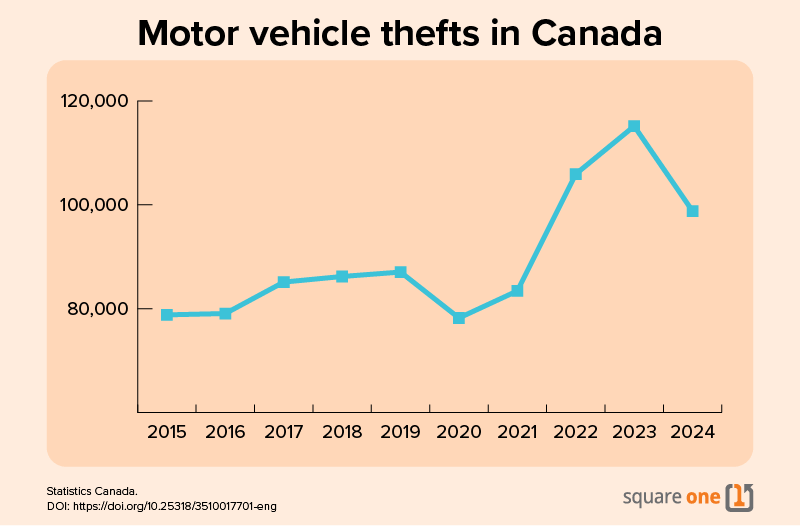
Vehicle theft is a significant factor in rising car insurance rates. In 2023, Canadian insurance providers spent $1.5 billion settling claims for stolen vehicles.9 Theft rates declined 19% in the first half of 2025, but theft rates and resulting claims costs remain high.10

Line graph showing the number of vehicle thefts reported in Canada each year from 2015 through 2024.

For this reason, most insurance providers offer discounts or other incentives for vehicles equipped with qualified anti-theft systems. That’s especially true for models that are high-risk targets — sometimes owners of such cars have to pay a surcharge if they don’t have the right anti-theft system.11

If your car has any aftermarket theft prevention devices, make sure to inform your insurer. They are aware of factory-installed systems, but they have no way of knowing about devices installed after purchase.

Square One offers car insurance discounts for a range of approved anti-theft devices, like engine immobilizers or alarm systems. The best discount is provided to vehicles equipped with a Tag system.

Commonly asked questions

How do you troubleshoot a car security system?

Common issues with car security systems not working often arise from batteries. If the battery in your key fob is dead, it won’t be able to transmit the signal that tells the car to unlock or start. If the battery in your car is dead, it won’t be able to do much of anything.

If the issue is that your car alarm is triggering too often, it may be because of a faulty sensor or switch. A low battery can also cause issues with the alarm. If your car’s alarm has adjustable sensitivity, consider turning it down.

Many security system issues arise from electronic faults. If switching batteries doesn’t help, you may need to bring it to a mechanic for a detailed investigation.

Which anti-theft devices are ineffective?

No anti-theft device is perfect on its own; that’s why it’s so important to combine multiple security methods. However, a common mistake to avoid is overreliance on ineffective devices. For example, dashcams are useful devices for many purposes, but most aren’t effective anti-theft devices.

Similarly, factory-standard alarms (the kind that just make a lot of noise) aren’t known to actually reduce theft.2

What are some common mistakes to avoid with anti-theft systems?

Aside from avoiding ineffective anti-theft devices or over-relying on a single device, there are a few other common mistakes to avoid.

For one, don’t neglect common sense: lock your car, and don’t leave the keys in it. This includes when you’re just stepping away from the vehicle for a moment, such as when you’re pumping gas or taking a quick trip into the convenience store. Always shut the vehicle off and take the keys with you.

Reports indicate that 40–50% of stolen cars were unlocked at the time of the theft.12 13 Another report says about 40% of thefts featured the keys being left inside the vehicle.14 The best anti-theft systems won’t help you if you don’t take basic measures to protect your car.

Another mistake is choosing low-quality anti-theft devices. Club locks can be effective, but not if a thief can rip them off with their bare hands. Tracking devices are helpful, but only if a thief can’t find them and discard them.

Sources

  1. Harris, Tom and Sascha Bos. “What to Do if Your Car Alarm Keeps Going Off.” HowStuffWorks, 15 March 2024, auto.howstuffworks.com/car-alarm.htm.
  2. Hazelbaker, Kim. “Insurance Industry Analyses and the Prevention of Motor Vehicle Theft.” Business and Crime Prevention, 1997, pp. 283–293.
  3. Dyson, Dylan. “Tips to Stop Your Vehicle from Being Stolen.” CTV News, 21 November 2023, www.ctvnews.ca/ottawa/article/tips-to-stop-your-vehicle-from-being-stolen.
  4. “Anti-theft Device Now Mandatory in Canadian-made Vehicles.” CBC News, 1 September 2007, www.cbc.ca/news/canada/anti-theft-device-now-mandatory-in-canadian-made-vehicles-1.677141.
  5. Woodward, Jon. “Anti-theft Immobilizers in Cars Are Now Obsolete. What Can Replace Them?” CTV News, 18 January 2023, www.ctvnews.ca/toronto/article/anti-theft-immobilizers-in-cars-are-now-obsolete-what-can-replace-them.
  6. Sommerfeld, Lorraine. “Lorraine Explains: Owner’s Car Warranty Voided After Installing Alarm.” Driving.ca, 4 October 2023, driving.ca/column/lorraine/car-warranty-voided-after-installing-alarm.
  7. Allain, Rhett. “The Physics of Faraday Cages.” Wired, 27 October 2023, www.wired.com/story/the-physics-of-faraday-cages.
  8. “Friday June 9, 2023.” The Current from CBC, 9 June 2023, www.cbc.ca/radio/thecurrent/friday-june-9-2023-episode-transcript-1.6872128.
  9. Insurance Bureau of Canada. “New Data Shows Severity of Canada’s Worsening Auto Theft Crisis — Theft Insurance Claims Top $1.5 Billion in 2023.” ibc.ca, 16 May 2024, www.ibc.ca/news-insights/news/new-data-shows-severity-of-canada-s-worsening-auto-theft-crisis.
  10. Vennavally-Rao, John. “Despite Car Theft Numbers Dropping, Experts Say Insurance Rates Won’t.” CTV News, 29 July 2025, www.ctvnews.ca/business/autos/article/car-theft-numbers-are-dropping-but-will-your-insurance-rates.
  11. Sommerfeld, Lorraine. “Lorraine Explains: Insurers Adding $1,500 Surcharge on Canada’s Most Stolen Vehicles.” Driving.ca, 5 August 2024, driving.ca/column/lorraine/car-theft-insurance-rates.
  12. Gilks, Sonya. “Lock Your Vehicle to Prevent Theft.” fredericton.ca, 5 September 2024, www.fredericton.ca/your-government/news/lock-your-vehicle-prevent-theft.
  13. “Canada’s Most Stolen Vehicles in 2024—And How to Protect Yours.” CDSPI.com, www.cdspi.com/learn/canada-most-stolen-vehicles-in-2024. Accessed 19 September 2025.
  14. “Protect Your Vehicle Keys! Nearly 90 Per Cent of All Thefts Involve the Use of Keys.” Manitoba Public Insurance, 16 December 2019, www.mpi.mb.ca/protect-your-vehicle-keys-nearly-90-per-cent-of-all-thefts-involve-the-use-of-keys.

Want to learn more? Visit our vehicle owner resource centre for dozens of helpful articles. Or, get an online car insurance quote in under 5 minutes and find out how affordable personalized coverage can be.

About the expert: Jil McIntosh

Jil McIntosh writes professionally about a variety of automotive subjects, and has contributed to such publications as Driving.ca, AutoTrader.ca, Automotive News Canada, Old Autos, Toronto Star Wheels, and more. A member of the Automobile Journalists Association of Canada (AJAC), she has won numerous awards for her writing, including Automotive Journalist of the Year.

Computer

Get a free quote

Get a personalized online home insurance quote in just 5 minutes and see how much money you can save by switching to Square One.

Get an online quote now

People

Protect your family

Even when you take precautions, accidents can happen. Home insurance is one way to protect your family against financial losses from accidents. And, home insurance can start from as little as $15/month.

Learn more