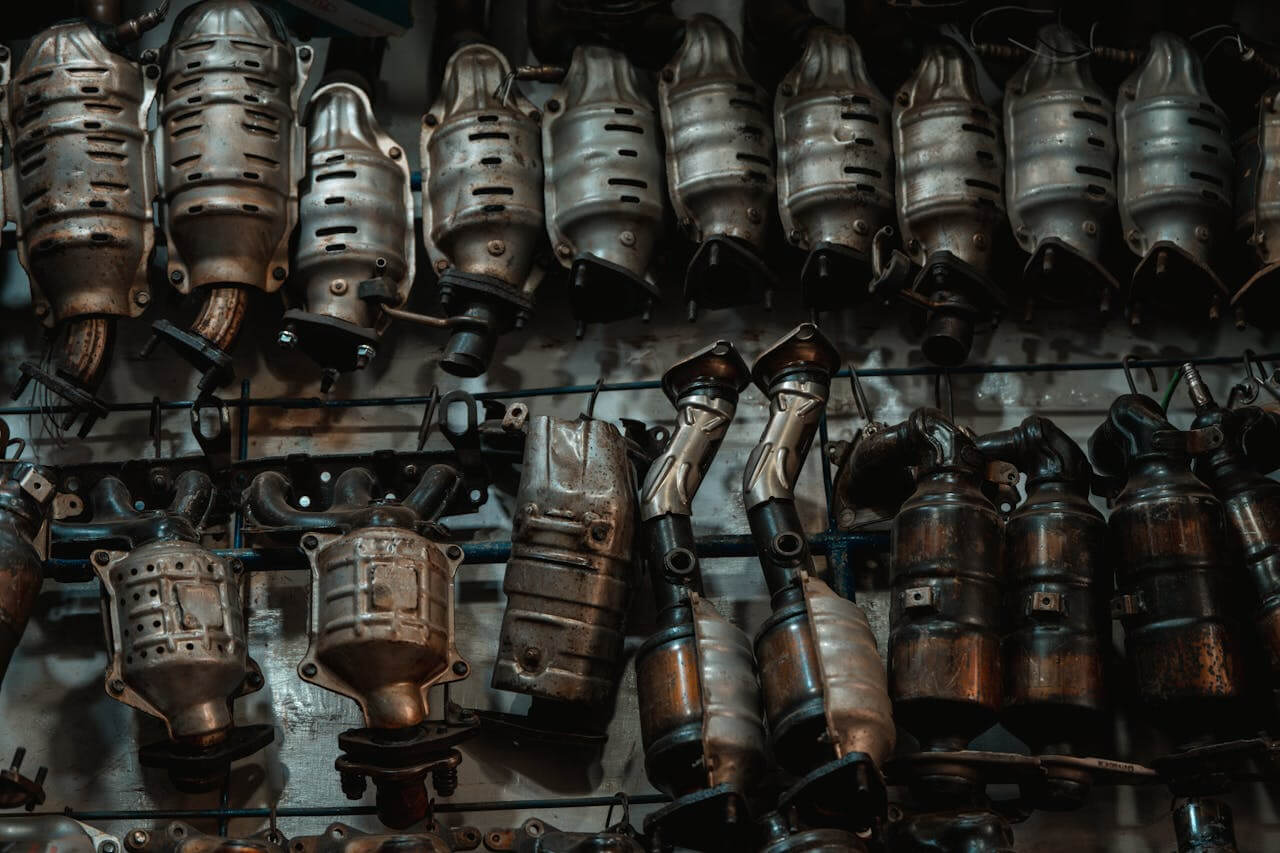
What are the indicators of a stolen catalytic converter?
You likely won’t notice anything wrong just by looking at your car from the outside. Once you start the car, however, the signs are unmistakable.
The first clue is the sound. When you start the engine, the exhaust will be much louder than usual, because the thief has cut the exhaust pipe and the exhaust is no longer going through the muffler.
Moreover, the ‘check engine’ light will be on the instrument cluster. This can also appear if the converter is still intact, but was damaged by an attempted theft.
While stealing the catalytic converter, thieves can also potentially damage other components. Before you drive off to a repair shop, make sure there aren’t pipes hanging down or other obvious signs that the vehicle shouldn’t be driven.
What to do if your catalytic converter is stolen
If you arrive at your car and suspect your catalytic converter is missing, take these steps:
- Call the police. This step is important: your insurance provider will require a police report to process a claim, and the report helps law enforcement track theft patterns in your area. If you witness a theft in progress, call 911. You’ll be asked for details, so note the location, the thief’s appearance, and, if possible, the licence plate of any vehicle the thief uses for the getaway.
- Don’t drive the vehicle any farther than necessary. Moving the vehicle risks additional damage to the exhaust system. Ask the police what you should do. If they say it’s safe to do so, leave the vehicle where it is, and arrange to tow it to a repair shop.
- Contact your car insurance provider. Even if you plan to pay out of pocket for the repairs, policies stipulate that you report the loss to your insurer. Have your policy number, the police report number, and your vehicle details ready. Ask your insurer if you should consider filing an insurance claim instead.
Insurance considerations
Speaking of insurance, your car insurance policy will typically cover any car-related theft if you have comprehensive coverage. All perils and specified perils coverage will also cover such theft. However, you must add this protection before the theft occurs; coverage won’t apply if you do so after the fact.
If you do have coverage, you’ll incur a deductible on the repairs. This is the amount you must pay before your policy covers the rest.
Importantly, many insurers reward those who install anti-theft devices on their vehicles. For example, Square One customers with aftermarket alarm systems or VIN (vehicle identification number) etching on their vehicles may qualify for a discount.
How to protect your catalytic converter
There are several anti-theft measures you can take to deter a catalytic converter thief. Hopefully, if you make it as annoying and strenuous a job for them as possible, they might move on to an easier target.
Park strategically
Where and how you park matter enormously. Parking in an enclosed, locked garage is the best defence. If that’s not an option, opt for well-lit areas, preferably with visible security cameras, or spots with heavy foot traffic where a thief would feel exposed.9
If you have outdoor driveway parking, consider installing motion-sensor lights and security cameras, as these can draw attention to anyone approaching the vehicle.
And, avoid leaving your vehicle in isolated areas overnight.
Install an aftermarket alarm system
Alarms provide an additional layer of defence, but they have their limits.
Some factory car alarms have motion sensors, but if yours doesn’t, consider an aftermarket system that does. Depending on the type you buy, these can be mounted directly onto the catalytic converter or the exhaust system, where they will be triggered by a thief who’s trying to cut through the exhaust pipe.
Some models, like the EASYGUARD alarms, come with a remote control that lets you adjust the bell sensitivity, sound, and volume. But, because they’re battery-powered and require manual activation, their effectiveness depends entirely on the owner remembering to arm the system.
Install a physical anti-theft device
Several aftermarket devices are designed specifically to protect catalytic converters. They won’t make theft impossible, but they significantly raise the amount of time, effort, and noise required to do so — often enough to make a thief reconsider.
If you’re willing to invest a few hundred dollars, these barriers offer both a visual and physical deterrent:
- Converter cages and clamps. Products like the CatClamp use aircraft-grade steel cable that is wrapped around the converter and anchored to the vehicle’s frame. Cutting through them requires considerable time, and sometimes, multiple saw blades — neither of which a thief in a hurry wants to deal with. Cages are best if your vehicle has a large, easily accessible chassis.10
- Converter shields. These are plate-shaped barriers that fully cover the converter area. They often require installation from a mechanic, but they’re dense and rigid enough not to be cut through easily. The Cat Shield by MillerCAT is a well-regarded option for many Toyota, Honda, and Lexus models.
- Converter straps. Products like the CatStrap wrap the converter in a heat-resistant sleeve containing layers of hardened steel. Any thief attempting to cut through will rapidly dull their saw blades. If that’s not enough, they also emit a deafening, ear-piercing noise when cut, which is attention no discreet thief wants.
Etch your VIN into the converter
One of the best deterrents to catalytic converter theft is VIN etching. This method involves permanently engraving the car’s VIN directly onto the unit. Typically, engraving services will pair this with window sticker labels on your car to deter potential perpetrators.
VIN etching is effective because it makes it harder for the thief to sell the converter. If a metal dealer sees a VIN on a converter, they’ll consider it a red flag. And if a stolen, etched converter is recovered by police, it can be traced back to the original owner.
Several Canadian police departments and municipalities offer free or low-cost etching programs. In Surrey, BC, the RCMP’s “You Etch It. We Catch It” program was credited with reducing local catalytic converter thefts by 76% in one quarter.11 It’s worth checking whether a similar program operates in your area.
High-temperature paint is another option. This involves applying a coat of brightly coloured paint to the converter, making it stand out as a marked part.
Commonly asked questions
How much does it cost to replace a stolen catalytic converter?
Replacement costs for a stolen converter can range from a few hundred to thousands of dollars.
The most expensive factor is the labour. If you go with a mechanic (which is usually your safest bet), expect to pay between $1,500 and $3,000 for most mainstream car models.12 The price will rise if the thief damaged other parts of the exhaust system, such as the oxygen sensors. Luckily, insurance can help with these expenses.
If you’re mechanically inclined, you may consider buying a converter and installing it yourself, but don’t attempt it if you’re not completely sure what you’re doing.
Can you drive without a catalytic converter?
Technically, yes, if you replace the section of exhaust pipe where the converter was; but legally, no.
Your car will still mechanically run without one, but you’ll likely run into problems sooner or later. For example, you might eventually experience engine misfires or stalling.
If your car is ever called in for inspection, the exhaust system may be tested. The car may be deemed non-compliant if it fails to meet provincial emissions standards.
Sources
- Alberta Motor Association. “Catalytic Converter Theft.” ama.ab.ca, ama.ab.ca/community/build/crime-prevention/vehicle-theft/catalytic-converters. Accessed 23 April 2026.
- Braund, Ethan. “Catalytic Converter Thefts Up 60% Year-on-Year in Canada: Report.” The Ashcroft Cache Creek Journal, 12 June 2023, ashcroftcachecreekjournal.com/2023/06/12/catalytic-converter-thefts-up-60-year-on-year-in-canada-report.
- Sandstorm, Alison. “Alleged Thief Arrested with $100,000 in Catalytic Converters.” CTV News, 3 August 2023, www.ctvnews.ca/kitchener/article/alleged-thief-arrested-with-100000-in-catalytic-converters.
- Smith, Steve. “Scrap Catalytic Converter Prices in Canada [2026].” Schmidt’s Auto Recycling, schmidtsautorecycling.ca/scrap-catalytic-converter-prices-in-canada. Accessed 23 April 2026.
- Garrett, Catherine. “Surrey man charged after allegedly selling 400 stolen catalytic converters.” vancouver.citynews.ca, 26 June 2024, vancouver.citynews.ca/2024/06/26/surrey-burnaby-stolen-catalytic-converters-charges.
- Olsen, Patrick. “Catalytic Converter Theft: 10 Most Targeted Vehicles.” CARFAX, 21 May 2024, www.carfax.com/maintenance/catalytic-converter-theft.
- Vancouver Police Department. “Police investigating rash of catalytic converter thefts.” vpd.ca, 10 July 2026, vpd.ca/news/2026/07/10/police-investigating-rash-of-catalytic-converter-thefts/.
- Manitoba Public Insurance. “Prevent Catalytic Converter Thefts.” mpi.mb.ca, www.mpi.mb.ca/prevent-catalytic-converter-thefts. Accessed 23 April 2026.
- Government of British Columbia. “Province Works with Industry to Stop Catalytic Converter Thefts.” news.gov.bc.ca, 14 February 2024, news.gov.bc.ca/releases/2024PSSG0005-000197.
- Keeler, Katherine and Gannon Burgett. “Tested: Best Catalytic Converter Anti-Theft Devices for 2025.” Car and Driver, www.caranddriver.com/car-accessories/g44546366/best-catalytic-converter-theft-prevention-devices-tested. Accessed 24 April 2026.
- Nerman, Danielle. “Catalytic converter thefts are dropping. It’s no coincidence that metal prices are falling, too.” CBC Radio, 20 July 2024, www.cbc.ca/radio/costofliving/catalytic-converter-thefts-dropping-police-say-1.7265079.
- Turner, Brian. “Catalytic converter: What are they and why are they stolen” Driving.ca, 21 September 2023, driving.ca/column/corner-wrench/your-corner-wrench-what-if-someone-swipes-your-catalytic-converter.
Want to learn more? Visit our vehicle owner resource centre for dozens of helpful articles. Or, get an online car insurance quote in under 5 minutes and find out how affordable personalized coverage can be.
About the expert: Jil McIntosh
Jil McIntosh writes professionally about a variety of automotive subjects, and has contributed to such publications as Driving.ca, AutoTrader.ca, Automotive News Canada, Old Autos, Toronto Star Wheels, and more. A member of the Automobile Journalists Association of Canada (AJAC), she has won numerous awards for her writing, including Automotive Journalist of the Year.