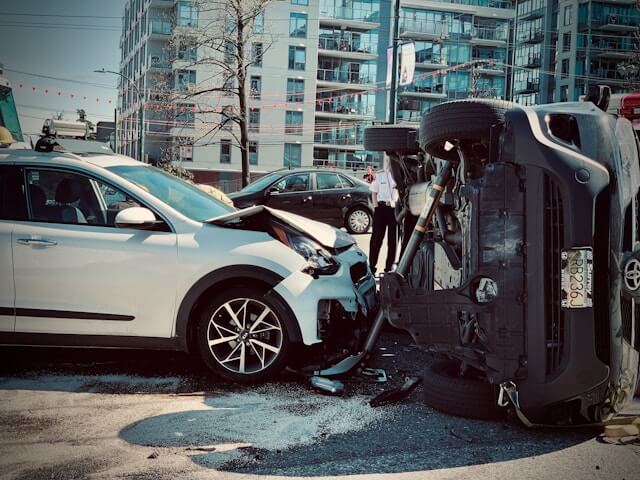
Who’s at fault in a T-Bone accident?
In most T-bone collisions, the driver who failed to yield the right-of-way would typically be found at fault. Most of these accidents don’t happen by chance; they’re usually the result of one (or both) drivers’ negligence.
Common at-fault scenarios include:
- A driver running a stop signal and striking a vehicle that had the right to cross the intersection.
- A driver making a left turn who fails to yield to oncoming traffic and is struck.
- A driver pulling out of a private driveway onto a main road without ensuring the path is clear.
- In a parking lot, a driver pulling out of a feeder lane fails to yield to a vehicle already travelling in a thoroughfare lane.
- At an uncontrolled intersection, the driver who fails to yield to the vehicle that arrived first, or if arriving simultaneously, the vehicle to their right.
Deciphering fault is the job of insurance companies, which they’ll typically sort out after you file your insurance claim. So, rather than debating with others at the crash scene, your focus should be on collecting any evidence you can. Useful evidence includes photos of the crash site, witness statements, and the other driver’s insurance information. If anyone is injured, contact the police immediately.
Crucially, never admit fault, even if you believe you caused the accident. If the incident ends up in a courtroom, the legal process will refer to the established fault determination rules for vehicle accidents in your specific province.
Applicable car insurance coverages
Like any accident, you’ll need certain coverages on your car insurance policy to be reimbursed for losses resulting from a T-bone.
- Collision coverage. This covers repairs for damage to your own vehicle when you’re at fault in a T-bone collision. It’s usually an optional coverage, but you must have it on your policy before the incident occurs to use it.
- Direct Compensation for Property Damage (DCPD). This covers damage to your vehicle when the other driver is at fault. DCPD exists in many provinces that don’t have public auto insurers, like Ontario. To claim DCPD, it must be on your policy before the accident.
- Accident benefits coverage. This is a standard feature of most car insurance policies, though many benefits are optional in Ontario. It offers compensation to those injured in an accident, regardless of who’s at fault.
- Third-party liability coverage. This is part of every car insurance policy by default. It protects you if you are legally responsible for damage or injury to others involved in a T-bone or any other accident.
Collision and DCPD are the only coverages from this list with a deductible. Unless you were entirely blameless (or zero percent at fault), you’ll have to pay this deductible when you make your collision claim.
Keep in mind that these coverages only apply to standard vehicle use; accidents resulting from illegal activities like racing, speeding, timing or rallying won’t be covered by insurance.
Related articles
Tips for avoiding a T-bone accident
While you can’t control other drivers, you can adopt smart driving habits to reduce your risk of getting T-boned.
- Be extra cautious at intersections. Always scan the cross-traffic before you enter an intersection. Never turn until you’re 100% certain that oncoming traffic is clear or has stopped for their red light or stop signal.
- Eliminate distractions. This one should be obvious: your eyes and mind should be on the road at all times, especially when approaching any cross-traffic. Shifting your focus even for a split second can leave too little time to react.
- Control your speed. Remember, you can’t out-brake bad physics. On any road, stick to the posted speed limit — it’s there for your safety. When approaching intersections or other high-risk areas, cover your brakes in case you need to avoid a close call.
- Assume the worst. It might be a great life motto to assume the best in people, but on the road, it’s smart to assume the worst. For example, if a car is reversing into your path in a parking lot, there’s a chance it’s because they haven’t seen you, even if you had the right of way. Even advanced rear cross-traffic sensors have a limited field of view. When in doubt, give other drivers room to make mistakes.
Commonly asked questions
What are the insurance implications of a T-bone accident?
They can be significant, mainly because T-bones often result in severe injuries and major vehicle damage.
If you’re found to be the at-fault driver, your own collision coverage (if you have it) would pay for your car’s repairs, but you’d have to cover your deductible. If the accident occurs away from your home province, you may need your liability insurance to cover the other party’s medical bills and vehicle repairs.
If the other driver is at fault, your policy’s DCPD coverage (if you live in a province that has DCPD) would cover the repairs to your car.
Either way, an at-fault T-bone accident is very likely to cause your insurance premiums to increase at renewal time.
What are the factors for the high collision rate of young drivers?
Young drivers — meaning under 25, but particularly teenagers — are involved in a disproportionate number of collisions, both T-bone and otherwise.
Young drivers are more frequently involved in accidents that arise from a failure to yield, or from careless operation. Careless operation comprises rear-end accidents, illegal lane changes, and similar incidents.2
What is the average payout for T-bone accidents in Canada?
There is no useful way to average the payouts for T-bone (or other) car accidents, as settlements are based on numerous factors. For example, an accident could result in a $500 door repair, an $18 million injury settlement, or anything in between.
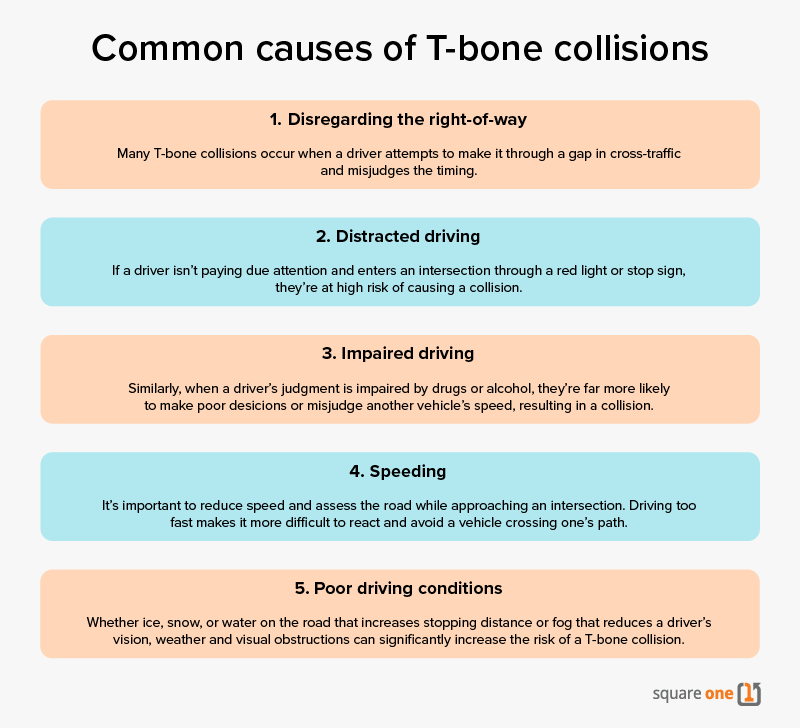
Infographic
Sources
- Desapriya, Ediriweera, et al. “The Risk of Injury and Vehicle Damage Severity in Vehicle Mismatched Side Impact Crashes in British Columbia.” IATSS Research, Vol. 29, Issue 2, 1 July 2005, pp. 60–66.
- Rahman, Ashifur, et al. “Understanding the Contributing Factors to Young Driver Crashes: A Comparison of Crash Profiles of Three Age Groups.” Transportation Engineering, Vol. 5, 100076, September 2021, doi.org/10.1016/j.treng.2021.100076.
Want to learn more? Visit our vehicle owner resource centre for dozens of helpful articles. Or, get an online car insurance quote in under 5 minutes and find out how affordable personalized coverage can be.
About the expert: Sunny Dhiman
Sunny has been with Square One since 2017, and presently holds the title of Call Centre Manager. Sunny is responsible for training and coaching new and existing employees. He also advises on complex underwriting, quote, or policy related matters. Sunny has a level 2 general insurance licence in BC, Alberta, Manitoba, and Saskatchewan. He has an OTL licence in Ontario and an AMF licence in Quebec. Sunny is also working on CAIB and CIP designations.