Updated April 10, 2026 | Published March 18, 2014
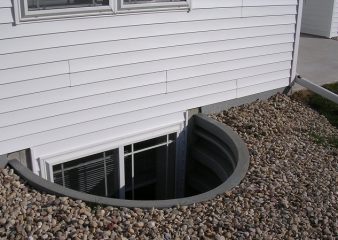
Window wells are semi-circular cut-outs that surround below-grade windows, allowing light into the basement.
Like any home system, window wells require maintenance and professional implementation. In fact, improper fitting can result in leaks to your basement. Many homeowners mistake this for a problem with their windows, leading to unnecessary and ineffective replacements.
This article explains how to maintain your window wells and how to identify potential issues.

A window well is a recessed space around a basement window, providing a space between the window and the surrounding earth to allow light into sub-grade rooms. In some cases, window wells also provide an emergency point of egress. Properly installed window wells also play an important role in draining excess rainwater away from your foundation.
When installing a window well, the builder will excavate the earth around the window. Usually, this hole is dug to a depth of around 30 centimetres beneath the bottom of the window sill. To avoid water pooling in the recess, the well should be partially filled with gravel, and sometimes a drain that connects to your perimeter drain is installed. This added safety measure will ensure that water can’t gather in the well and exert force on the windows, causing them to crack or leak.
If your window wells don’t already have a drainage system, contact a professional about getting one installed. In some cases, the process can involve making alterations to your foundation. It may be expensive, but avoiding water damage to your foundation or basement will save money in the long run. A contractor will also be able to advise on the best type of drainage system for your property.
Exterior drains sit in the gravel pit at the bottom of your window well. They extend to the base of your foundation and are connected to your perimeter drain (or weeping tile).
Interior drains redirect rainwater to your sump pump. Water is then moved away from the property through a network of pipes. As sump pumps are located inside the property, this method requires cutting a hole in your foundation wall to connect the sump pump to the window well.
Once drainage has been taken care of, a plastic or steel window well is placed in the hole to prevent the earth from falling back in. The remaining space surrounding the window well is filled with dirt which should be compacted and graded so that water drains away from, not towards, the window.
The City of Edmonton provided a useful guide for homeowners that includes tips on preventing water damage from window wells. They advise homeowners to ensure that the outer edges of their window wells sit tight and flush against the basement wall in order to prevent leaks. Click here to take a look at the guide in full.
The most important maintenance task is periodically clearing the debris from your window wells. Do this twice a year; once in autumn and once in spring. Ensure that any pipes that are part of your drainage system are also clear. It’s also important that the gravel in your window well is loose. This will allow water to effectively drain to the perimeter drain. If the gravel becomes compacted, or if it’s improperly installed with sand, its efficacy is compromised.
A clogged drain can result in water backup, which pressures the glass. This can have a variety of adverse effects, ranging from water seeping through porous concrete, leaving damp on the inside of your walls, to broken windows and interior water damage.
Homeowners interested in preventative maintenance should consider a window well cover. While various types are available (mesh, plastic bubble covers, grill-type, etc.), their purpose remains simple: prevent debris from entering the window well by providing a physical barrier between the well and the elements. Most covers are designed to still permit light to enter your basement, too.
Once your window well is installed, adding a cover is quick and easy, and something most homeowners will be able to do themselves.
ready for an online quote? Your time matters, and so does your stuff. Get a personalized home insurance quote in 5 minutes. That’s less time than it takes to wait in line for coffee.
Before you start, please review our Privacy Policy and Terms of Use.
Here are 5 common issues to look out for, and what you can do to prevent damage:
Snow, leaves, or other debris piles up: During autumn, clear fallen leaves regularly. During winter, check your window wells to ensure that compacted snow or ice isn’t blocking your drainage system.
Gravel becomes like cement: Over time, wet sand and dirt can clog up the gravel, and will prevent water from draining. Shovel out the gravel, and either replace it with new gravel, or simply spread it out, and rinse away any dirt, sand, or other debris, and shovel the clean gravel back into the well.
Insecure fastening: As your house settles, window wells can become misaligned with the foundation. This allows dirt to push in and clog the drainage system. If this happens, the window well may need to be dug out again, and a new well attached to the home. Window wells should always fit tightly against the basement wall.
Water on the floor beneath the basement window: To determine whether drainage is the problem, run water from a hose into the well to see how quickly it drains away. The water level may rise above its base, but shouldn’t approach the bottom of the window. If water is draining as it should, there may be a completely different issue, such as a crack in the home’s foundation near the window, which is allowing water to enter.
Soil enters the well and plugs the drain: Soil can enter the well and cause problems if the window well is the wrong size. If it’s too narrow, soil may push in from the sides. Or if the well is too short, water may wash over the sides, carrying soil with it, and plugging the drain. Remember that window wells are available in all shapes and sizes so be sure to measure your window and consult an expert before installation.
A recent report found that the average cost of a flooded basement in Canada was $43,000. As window wells sit below-grade, it’s important to keep on top of any potential problems to avoid water damage to your home.
Your home insurance provider will want to know if you’ve ever had water damage in your basement, and if so, what steps you’ve taken to prevent it from happening again. They may ask whether you have functioning drains in any window wells, so it’s a good idea to be aware of your home’s systems. Having well-maintained window wells and drains shows your insurance provider that you’re a responsible homeowner and care about preventing damage to your home.
Window wells are necessary if the home has any windows below grade—like basement windows. In many jurisdictions, building codes require all below-grade windows to have wells that meet certain specifications. Check your local building codes to be sure.
Concrete window wells are the best, being durable and long-lasting. They may be more difficult to install, but the effort is worthwhile. Plastic or metal window wells degrade more quickly over time, negating cost savings in the long run.
Usually, a window well should be about 20 centimetres deeper than the bottom of the window, and about 15 cm wider. Local building codes may stipulate different dimensions.
Want to learn more? Visit our Getting to Know Your Home resource centre for the complete rundown on all your home's systems and features. Or, get an online quote in under 5 minutes and find out how affordable personalized home insurance can be.
Check out these related articles:
Get a personalized online home insurance quote in just 5 minutes and see how much money you can save by switching to Square One.
Even when you take precautions, accidents can happen. Home insurance is one way to protect your family against financial losses from accidents. And, home insurance can start from as little as $15/month.

