Reviewed by Mike Sutton
Updated April 9, 2026 | Published February 4, 2014
A perimeter drain system is a system of pipes and drains around a building that collect water and channel it away from the building’s foundation.
Perimeter drains protect foundations from structural damage caused by water infiltration. If too much water accumulates near the foundation, it can cause cracks, mould, sinking, and many other issues. Perimeter drains are also called weeping tiles, drain tiles, French drains.
This article explains how perimeter drains systems work and what homeowners need to know about them.

A perimeter drain is a system that moves excess water away from the foundation of a house. Perimeter drains collect ground and surface water and channel it away from the building, preventing it from seeping into the basement or foundation. Most buildings have perimeter drain systems; without them, water from heavy rains or melting snow would accumulate near the foundation, eventually seeping in and causing significant damage.
Perimeter drains are also known as weeping tiles or French drains. Old systems used actual clay tiles to divert water. New systems no longer feature tiles, but the “tiles” name has stuck. Modern systems more commonly use perforated pipes to collect and channel water. The “French” in “French drains” comes from Henry French, who popularized the drainage method in the 1800s.
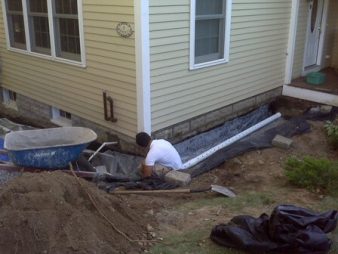
A perimeter drain includes a perforated pipe installed underground, around the perimeter of the house. The thousands of tiny holes or slits allow water to enter the pipe and drain away from the foundation. The pipe is often covered by a mesh permeable sock which prevents soil from getting inside.
The pipes are covered by layers of gravel of graduated sizes (largest close to the pipe, followed by smaller gravel), and finally backfilled with soil. The gravel allows water to flow towards the drainage pipe, without allowing dirt and debris to clog it up. The system slopes away from the home and carries the water towards the municipal storm or wastewater system.
When a house is constructed, a certain amount of dirt around the perimeter of the home is excavated. Once construction is finished, this dirt is put back into place, making it looser than the untouched soil next to it. Therefore, water runs more easily through this soil, which just happens to be right next to the basement or crawl space walls.
Proper sloping, in addition to properly functioning perimeter drains, is vital in preventing water seepage. Most experts recommend a downward slope, away from the foundation, of 6 to 15 centimetres over a distance of 3 metres.
But the drainage system itself needs to be sloped, too.
“We dig a French drain 14 inches wide by 14 inches deep,” says Mike Sutton of French Drain Man Canada. “When we build a system, we have a starting point which is higher in elevation, maybe 12 inches deep instead of 14 inches to create some slope. Gradually, we drop down to wherever the discharge point of the system is.
“Many people build systems with no discharge point and simply lay the pipe in the ground hoping for the ground to absorb the water eventually. That works over longer periods of time, yet can lead to issues when heavy rains and snowmelts occur.”
When a home is constructed, the builder is responsible for ensuring proper grading and will need to pass an inspection by a surveyor for the municipality, province, or state. It then becomes the homeowner’s responsibility to maintain the proper grade. If you plant trees, lay new sod, or put in a pool, you could be changing the way water drains away from the home.
If you’ve unintentionally caused water to run towards your neighbour’s property, you could be facing a lawsuit and will be responsible for any expenses to correct the situation.
A couple of indicators of a drainage problem are:
You may need to replace the whole system with modern plastic weeping tile, or in some cases, you can simply replace the damaged sections. Older homes sometimes have clay or concrete weeping tiles, which do tend to deteriorate, collapse, and become blocked with dirt and roots as they age.
You may be able to have the system flushed. A professional can dig access points around the basement walls to access the drain and clean it out. Some older drain pipes have ridges on the inside which make it impossible to clean. These would probably need to be replaced.
If the system is clogged up and flushing doesn’t clear it, there’s not much you can do besides having the pipes replaced. Perimeter drains are usually installed with a layer of gravel placed on top of the system, before the dirt is filled back in. This usually serves to prevent clogging, but it can fail. If you replace a clogged system, consider having a clean-out port installed with the new system.
ready for an online quote? Your time matters, and so does your stuff. Get a personalized home insurance quote in 5 minutes. That’s less time than it takes to wait in line for coffee.
Before you start, please review our Privacy Policy and Terms of Use.
Have your drain system inspected periodically, at least every three years, and immediately if you notice water stains on your basement walls or pooling water near your foundation. Hire an inspection company to stick a camera into the perimeter drain, to see if it’s functioning properly and identify blockages.
Sometimes cleaning may be all that is necessary, rather than a repair or total replacement.
Unfortunately, aging systems may be beyond simple maintenance; you may need to replace them with a modern, well-built perimeter drain system.
“Using quality materials is, first and foremost, our biggest tip,” says Sutton. “[We use] drainage tiles with more holes per linear foot, [and] we line the trench with non-woven geotextile fabric. This allows the water to get through to the pipe openings and keep dirt from entering the pipe.
“We only use a sock when the stone is crushed stone, which can create smaller rock fines that end up blocking the holes that allow water to seep into the pipe.”
Installing a new system with the right materials and design will make future maintenance a lot easer. For the most part, you’ll only need to periodically clean it out. If your system is designed right, you’ll be able to clean it out yourself.
“Having a clean-out access is one way to make sure you can flush the line with either high pressure water line or garden hose,” says Sutton.
Insurance companies will want to know if you have had any water in your basement. They may also ask about the condition of your foundation. A cracked foundation puts your basement at serious risk of water damage, and of course, damage by mould if the water damage isn’t addressed right away. Making sure your perimeter drain is working properly is one of the many things you can do to help waterproof your basement.
Some home insurance policies cover certain types of flooding. But, be sure to read your policy or talk to your insurance agent to fully understand what types of water damage are covered and what types are not.
Some policies cover rising ground water, while some won’t. Seeping of water into the basement is almost never covered by insurance, so it is even more important for you to take the proper steps to prevent it.
Removal of mould is another cost that is not normally covered by home insurance. The cost to clean up the resulting mess and make any necessary repairs will be coming out of your own pocket.
Accordingly, you may want to spend some money now to make sure your perimeter drainage system is in good repair and is working properly. Or, you could be facing even larger expenses later to repair any water damage to your home, as well as damage to property in your basement, that is not covered by home insurance.
Ultimately, though, the cost to maintain a working perimeter drain system is much less than the damage that can result from a broken system.
Always get a home insurance policy which provides the broadest form of water damage coverage possible, and be sure you know what is covered and what is excluded before anything happens.
Perimeter drains or weeping tiles can last for decades — 30 years or more for a modern system with proper maintenance.
If properly installed, you can expect to have a problem-free basement for a very long time. Older clay weeping tiles tend to deteriorate and become clogged with soil and tree roots, but even these systems last for many years.
The cost of retrofitting a home with a perimeter drain system varies, but can be expensive — well into the five-figure range. The volume of soil that needs to be moved is one major factor. The quantity (and quality) of the materials are also important. Plus, there’s the cost of labour — installing a perimeter drain system is a time-consuming process, one that most homeowners aren’t equipped to do themselves.
“A rough estimate is $65 to $80 per linear foot, which will include all labour, materials, and soil removal,” says Sutton.
Want to learn more? Visit our Getting to Know Your Home resource centre for the complete rundown on all your home's systems and features. Or, get an online quote in under 5 minutes and find out how affordable personalized home insurance can be.
About the expert: Mike Sutton
Mike Sutton is the owner of French Drain Man Canada, which has been building de-watering systems in Canada since 2019 for both residential and commercial builds. FDM Canada is the distributor of French Drain Man Products manufactured in the US, designed to move water quickly and efficiently.
Check out these related articles:
Get a personalized online home insurance quote in just 5 minutes and see how much money you can save by switching to Square One.
Even when you take precautions, accidents can happen. Home insurance is one way to protect your family against financial losses from accidents. And, home insurance can start from as little as $15/month.

